Lifecycle Segmentation
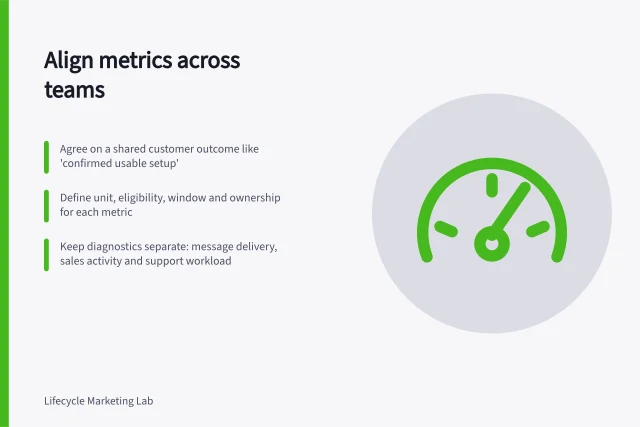
Agreeing on shared lifecycle metrics with sales and support
Agree on the population, outcome, window, exceptions and owner behind a shared lifecycle scorecard.
Archive
Lifecycle Segmentation
Agree on the population, outcome, window, exceptions and owner behind a shared lifecycle scorecard.
Channel Orchestration
Define shared contact limits across channels, check platform exclusions and time windows, and handle blocked or retried messages safely.
Journey Governance
Decide who owns each lifecycle stage’s meaning, event data and use in customer journeys.
Channel Orchestration
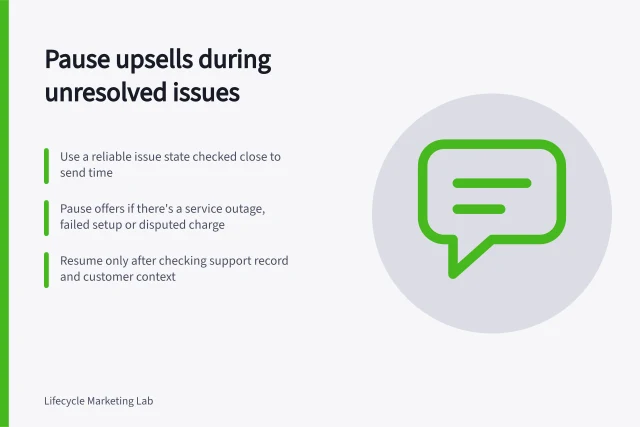
Pause commercial messages when relevant support issues are unresolved, then reassess the offer before any journey resumes.
Onboarding Journeys
Build an expired-trial path from verified access and billing states, with clear entry, exit and current-message checks.
Channel Orchestration
Build and verify a register of active customer journeys, including entry rules, waiting messages, sending systems and owners.
Lifecycle Experiments
Define reusable message modules with a clear purpose, current facts, allowed contexts, fallbacks and a review process for every channel version.
Channel Orchestration
Separate delayed data from message states after an outage, triage stale sends and verify a controlled restart.
Lifecycle Experiments
Choose a journey holdout using eligible volume, baseline outcomes, the smallest useful effect and the time available for a fair comparison.
Channel Orchestration
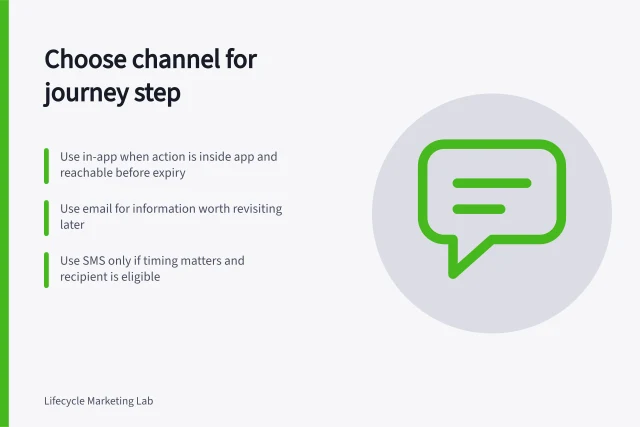
Choose email, in-app or SMS for one lifecycle step using the customer's task, timing, permission, display conditions and fallback.
Onboarding Journeys
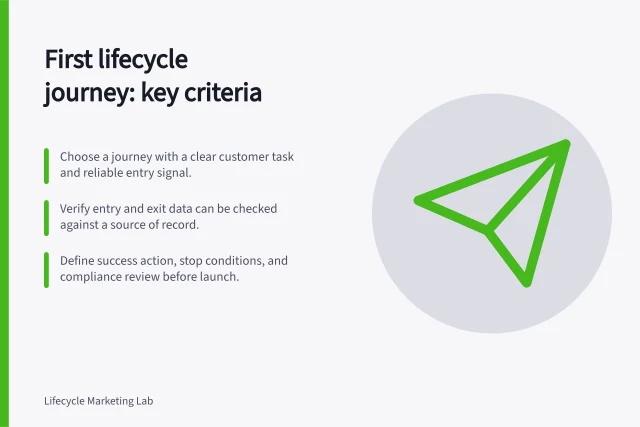
Select a first lifecycle journey using customer need, data reliability, send controls, readiness and a measurable outcome.
Onboarding Journeys
Choose an achievable first action that advances the customer’s signup goal, can be recognised as progress and leads to a clear next step.
Lifecycle Experiments
Compare eligible journey and holdout groups fairly by separating assignment from delivery, aligning outcome windows and checking contamination.
Onboarding Journeys
The first purchase-oriented message should follow the reason a person signed up.
Onboarding Journeys
Education and replenishment answer different questions.
Renewal Journeys
Map renewal roles to a specific agreement, share one decision state and check each contact’s need and eligibility before sending.
Channel Orchestration
Coordinate lifecycle responses across email, in-app and SMS with current customer evidence, shared stop rules and checks across sending systems.
Lifecycle Segmentation
Define reliable customer events, build lifecycle segments around clear decisions and check changing membership before sending messages.
Onboarding Journeys
Plan customer milestone journeys that recognise progress, check upgrade relevance, protect support conversations and measure expansion fairly.
Renewal Journeys
Assess whether a lifecycle journey still serves a customer need and plan the exit for new and active customers.
Onboarding Journeys
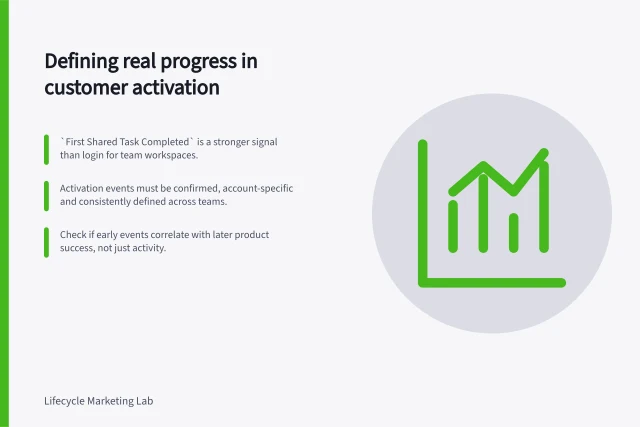
Choose an activation event tied to a customer's first meaningful result, specify it precisely and check what it says about progress.
Lifecycle Segmentation
Set an auditable lifecycle stage conversion rate with clear entry evidence, destination events, denominators and observation windows.
Channel Orchestration
Resolve overlapping lifecycle triggers with a precedence rule based on permission, current need, real deadlines and message validity.
Onboarding Journeys
Design an onboarding journey around a useful customer result, with relevant help, clear entry and exit rules, and checks for outdated messages.
Lifecycle Experiments
Use an eligible holdout and a shared outcome window to separate what a lifecycle message may add from progress customers make anyway.
Channel Orchestration
Learn when a single campaign is enough and when changing customer actions call for an orchestrated journey.
Lifecycle Experiments
Use trial tasks, failures and customer responses to distinguish product friction from stated price concerns.
Journey Governance
Record a live journey change’s rationale, affected customers, approvals, deployed settings and verified outcomes.
Lifecycle Experiments
Evaluate a first-purchase journey by asking whether it helps eligible people buy, and at what incentive cost.
Onboarding Journeys
Build a first-purchase journey from signup and buying signals, then stop prospect messages when an order is placed.
Onboarding Journeys
An abandoned account setup and an abandoned checkout indicate different unfinished tasks.
Onboarding Journeys
Handle reversals and corrected events by preserving history, updating current state and reviewing queued journey messages.
Channel Orchestration
Treat missing events and properties as unknown, diagnose the source and choose a safe journey-entry fallback.
Lifecycle Segmentation
Distinguish a meaningful upgrade need from weak activity signals using customer tasks, constraints, intent and a review of false positives.
Lifecycle Segmentation
Classify trial users with an unconfirmed useful result, separating no attempt, failed attempts and uncertain data.
Channel Orchestration
Use one approved offer record to align eligibility, benefits, exclusions and expiry across messages, landing pages and checkout.
Journey Governance
Build a lifecycle content map around customer questions, supporting evidence, content jobs and the conditions that make a message stale.
Lifecycle Experiments
Plan a lifecycle test with a clear customer outcome, fair assignment, a defined holdout and an honest readout of what changed.
Journey Governance
Plan lifecycle marketing around customer needs, observable progress, message controls and meaningful outcomes across the journey.
Journey Governance
Define entry, permission, exclusion, priority, send and exit rules so lifecycle messages remain accurate and appropriate.
Journey Governance
Keep live customer journeys visible, monitor entry and sending separately, respond to data outages and review operational faults.
Journey Governance
Assign owners for lifecycle definitions, live journey changes, shared outcomes and retirement decisions.
Journey Governance
Build a lifecycle measurement plan around eligible customers, verified progress, cohort windows, exceptions and a fair assessment of impact.
Lifecycle Segmentation
Turn lifecycle labels into inspectable action rules, with reliable events, clear limits and a way to handle unknown states.
Onboarding Journeys
Use current evidence to choose a message that answers one likely customer question without assuming an unverified motive or task status.
Lifecycle Experiments
Separate journey-eligible accounts, sales-owned deals and shared handovers before reporting expansion revenue or estimating impact.
Lifecycle Segmentation
Define customer types at onboarding entry, set a useful completion result for each and report rates with clear units and observation windows.
Onboarding Journeys
Define a first useful result, align onboarding cohort clocks and compare both time to value and the share of customers who reach it.
Lifecycle Experiments
An education journey should reduce questions it can genuinely answer, without making help harder to reach.
Lifecycle Experiments
Diagnose a fall in lifecycle journey entry by checking eligibility, event delivery, filters, repeat entry and reporting units.
Renewal Journeys
Define a verified contract decision, review queued renewal requests and check other channels before outdated outreach reaches the customer.
Onboarding Journeys
Post-purchase education should help a customer use what they bought.
Channel Orchestration
Find contradictory lifecycle messages across journeys, recheck their assumptions at send time and resolve collisions across separate queues.
Onboarding Journeys
Define completion and re-entry by person, account or task so duplicate events do not replay a finished lifecycle journey.
Lifecycle Experiments
Document an unfavourable or inconclusive journey test with its original decision, uncertainty, integrity checks and next action.
Onboarding Journeys
Audit onboarding messages for repeated or contradictory requests, set a priority for each customer situation and correct the send rules.
Renewal Journeys
Build a renewal journey around contract dates, decision states and account roles, with clear rules for reminders, negotiations and stopping outreach.
Journey Governance
Run a quarterly review of live journeys using current rules, exceptions, customer histories and specific follow-up decisions.
Lifecycle Segmentation
Keep lifecycle progress distinct from demographic and organisation traits, then combine fields only when each helps a clear decision.
Renewal Journeys
Keep renewal process notices aligned with live negotiations using clear message purposes, a named owner and a recorded handover state.
Onboarding Journeys
The useful order for product education follows what the customer can do now.
Channel Orchestration
Check for a completed order immediately before a first-purchase offer is sent, and skip or replace the offer when one exists.
Lifecycle Experiments
Use sample customer histories to verify sends, skips, holds, exits and unintended exclusions before a lifecycle journey goes live.
Lifecycle Experiments
Compare two journey schedules fairly while keeping the offer fixed, using one assignment clock and a shared customer-outcome window.
Channel Orchestration
Choose a trial upgrade-message moment from verified product use, then recheck the need, plan and permission before sending.
Channel Orchestration
Define a reliable milestone event, prevent duplicate entry and recheck customer context before each scheduled message.
Lifecycle Segmentation
Trace a product change through lifecycle messages, prioritise inaccurate claims and review shared content and queued sends before release.
Onboarding Journeys
An education journey should stop asking a customer to do something they already did.
Renewal Journeys
Plan renewal messages from the agreement’s real deadlines, account tasks and time zone, then update the schedule when contract dates change.