Lifecycle Experiments
Part of Post-purchase customer education journeys
Measuring whether education reduces avoidable service contacts
An education journey should reduce questions it can genuinely answer, without making help harder to reach.
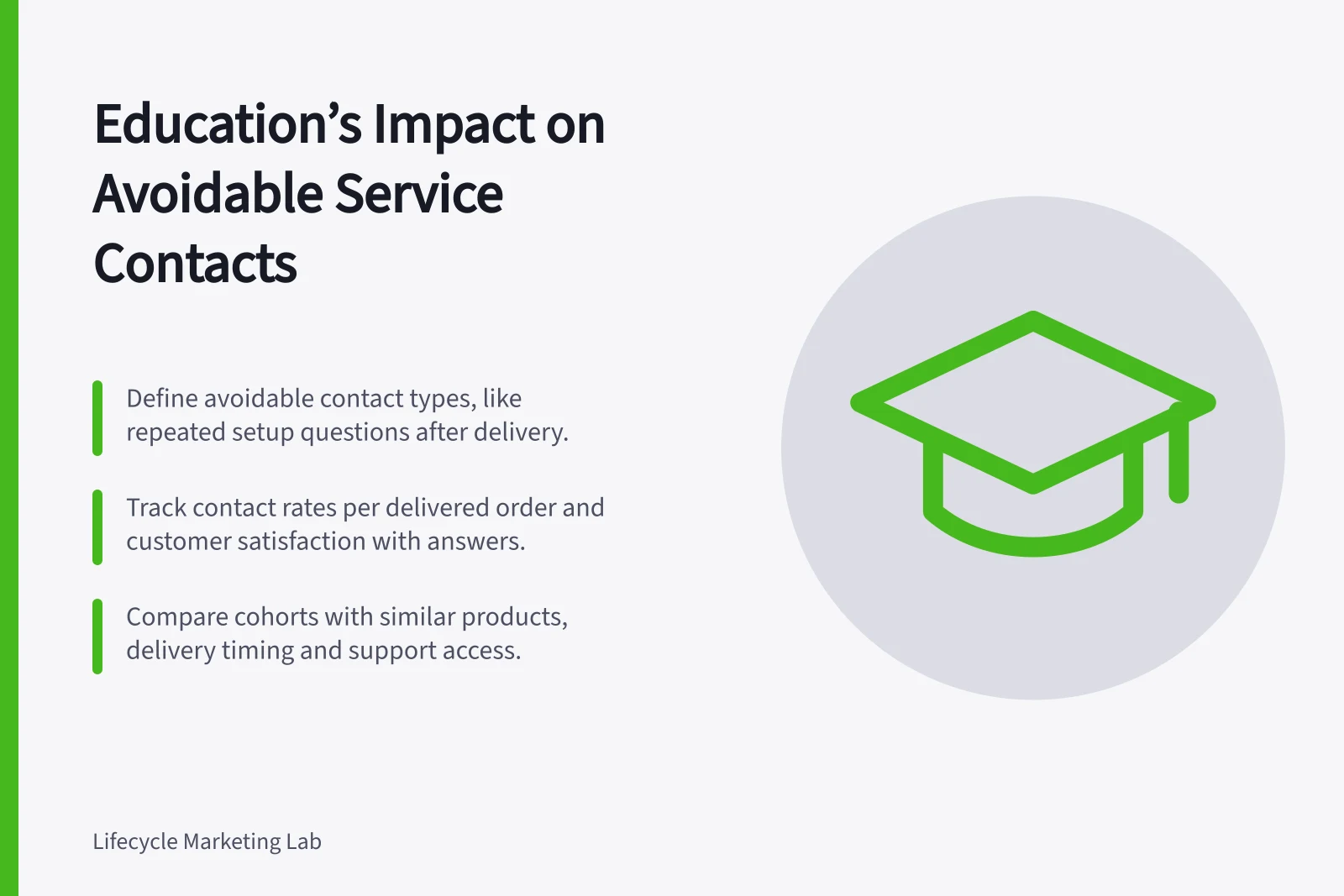
An education journey should reduce questions it can genuinely answer, without making help harder to reach. Define the avoidable contact type first: perhaps repeated setup questions after delivery.
Not every service conversation is a failure. Reports of defects or complex needs may be valuable signals.
Create a baseline for the same product and customer stage. Track the rate of the specific contact type per delivered order, successful setup or use, repeat contact and customer satisfaction with the answer.
Compare cohorts with similar products, delivery timing and support access. A fall in contacts alongside worse completion or more returns is not improvement.
Check whether the content was actually received and usable. Shopify documents post-purchase automations, but a send count does not prove reading or understanding.
Sample conversations to see whether agents still repeat the same instructions and whether the message omitted a critical step.
If scale allows, hold back education for a comparable group under appropriate customer-care safeguards, then compare outcomes. Otherwise describe the change as an association.
Keep a clear human support route and revise the content when a repeated question reveals a genuine gap.
Steps to Measure Education Impact on Avoidable Service Contacts
- Define the avoidable contact type (e.g., repeated setup questions)
- Establish a baseline using delivered orders and customer stage
- Compare cohorts with similar products, delivery timing and support access
- Verify content was received and usable (not just sent)
- Sample conversations for instruction repetition or missing steps
- Use controlled testing (hold back education for a group under care safeguards)
- Maintain clear human support route and revise content based on feedback