Lifecycle Segmentation
Part of Customer events and lifecycle segmentation
Separating lifecycle stage from demographic segment
Keep lifecycle progress distinct from demographic and organisation traits, then combine fields only when each helps a clear decision.
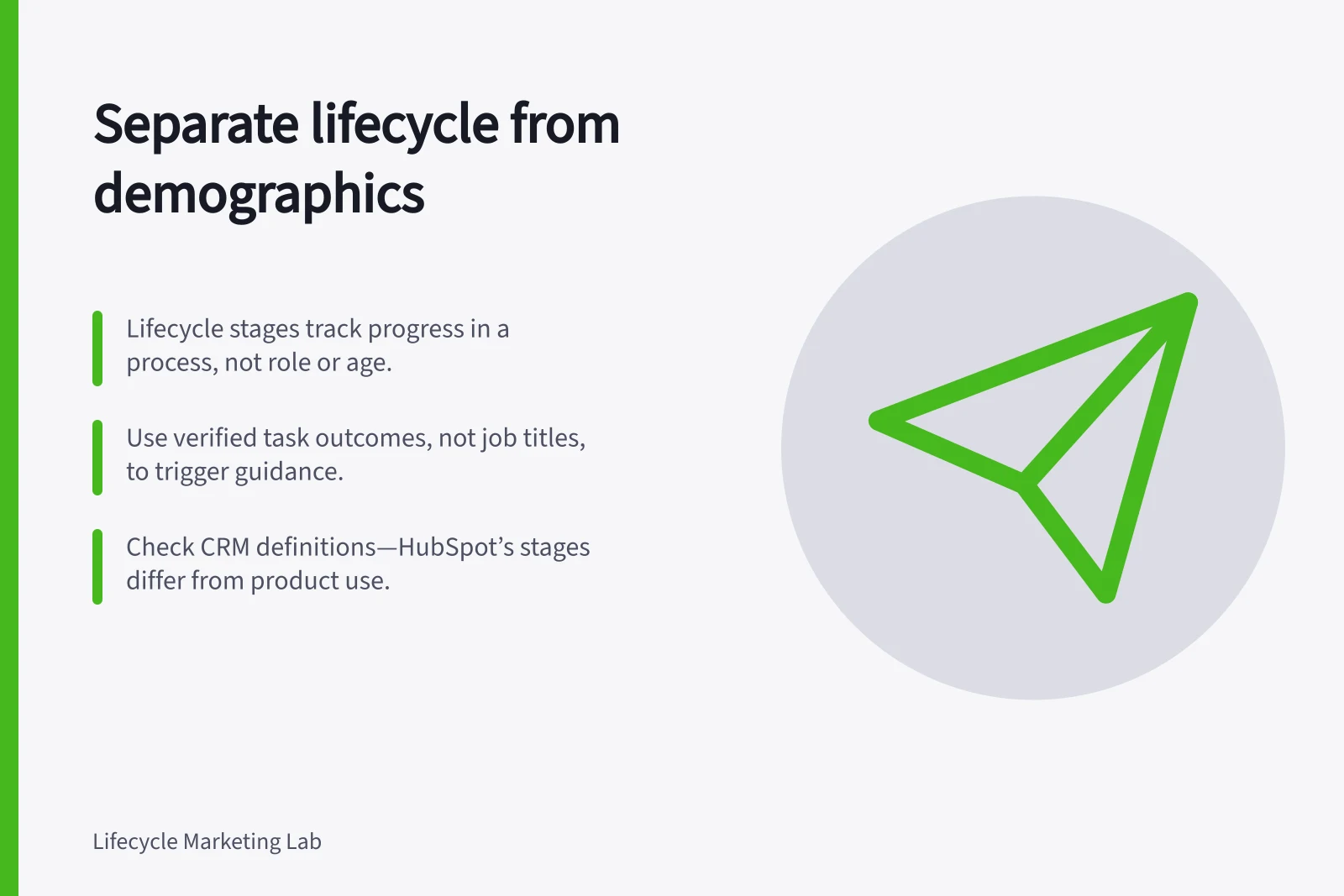
A lifecycle stage describes a customer's position in a defined journey or process. A demographic segment groups people by a characteristic, such as age or role.
Organisation size and industry are usually firmographic characteristics; region is geographic. None of these characteristics proves that someone completed setup, bought a product or began using a service.
Lifecycle Stage vs Demographic Segment: Key Differences
- Definition
- Position in a defined customer journey or process
- Example
- First confirmed use, active user, trial expired
- Definition
- Grouping by personal or organisational attribute
- Example
- Role (e.g., operations manager), organisation size, region
Keep the labels' jobs clear
| Field | What it describes | Example evidence |
|---|---|---|
| Current lifecycle stage | Where a person or account stands under a stated process definition | Current agreement state or confirmed progress on a task |
| Historical milestone | An outcome achieved at some point | First confirmed use or an accepted order |
| Customer characteristic | A person, organisation or location attribute | Role, organisation size or service region |
| Message eligibility | Whether a response is appropriate now | Permission, relevant need and exclusions |
A stage and a characteristic can both change. A person may change roles; an account may change plans; a stage may change after a reversal or correction.
Keep the field's source and update time visible. Do not treat an old profile value as current evidence.
Best Practices for Lifecycle and Demographic Segmentation
- Use current lifecycle stage to reflect real-time progressBased on confirmed task completion or agreement state
- Track historical milestones separatelyRecord events like first use or order acceptance
- Keep characteristic data distinct from behaviourDo not assume role or region implies usage status
- Maintain source and update time visibilityAvoid relying on outdated profile values
Do not use a characteristic as proof of progress
Suppose a software company serves operations managers and designers. Either role can include new customers, active users and people with a failed setup.
A rule that sends advanced guidance to every operations manager confuses role with observed use. Establish the relevant stage or task outcome first, then use role only if it changes which guidance helps.
For an account product, distinguish person and organisation fields. One employee's completed task may be an individual milestone, while the contract belongs to the account. Use a verified account relationship rather than a matching company name or email domain.
Twilio Segment, for example, supports user and group traits, but its documentation says destination support for multiple groups varies and it has no native way to remove a user from a group. Check how the actual systems maintain those relationships.
Combine fields for a clear decision
A segment can combine stage and characteristics while keeping their meanings separate. For example, a rule might select accounts with confirmed first use and a recorded Australian service region for local setup guidance.
The first condition describes progress; the second selects relevant content. If the region is missing, do not infer it silently from an email address or website visit.
Keep contact permission separate from lifecycle and location data. Check applicable rules before sending commercial messages. Neither a lifecycle stage nor a recorded location establishes permission.
Use a characteristic only when it improves the decision. If observed behaviour already answers the question, a demographic proxy may make the rule less precise.
Correct Approach to Customer Messaging Based on Lifecycle and Traits
- Confirm lifecycle progressVerify actual task outcome (e.g., first confirmed use)
- Validate contact permissionEnsure compliance with Australian spam laws (ACMA)
- Use relevant characteristics only if they improve decision-makingE.g., service region for localised guidance – not inferred from email domain
- Deliver message only when all criteria are metCombining verified stage and context-specific traits ensures relevance
Check the definition in the tool
A CRM's built-in lifecycle field may describe a different process. HubSpot's default stages, for example, represent marketing and sales progress, not present product use.
Its default automatic updates move its Lifecycle stage property forward. Define the field needed for the decision and document how it is maintained.
Review histories involving a role change, a plan change, a task completed by another user and a late event. If two customers share a characteristic but are at different points in the task, the rule should be able to give them different responses.