Onboarding Journeys
Part of Lifecycle marketing across the customer journey
Choosing the first lifecycle journey to build
Select a first lifecycle journey using customer need, data reliability, send controls, readiness and a measurable outcome.
Choose the first lifecycle journey where a clear customer need, a dependable entry signal, an appropriate response and an observable outcome meet. An opportunity is a poor first build if the team cannot tell who qualifies or when the response should stop.
Compare opportunities on five questions
List a few candidate moments, then ask:
| Question | What to look for |
|---|---|
| Is there a real customer task? | A question or obstacle the response can help resolve. |
| Can we identify entry reliably? | An event or state with a known source and timing. |
| Can we avoid wrong sends? | Current consent, completion and exclusion data. |
| Is the response ready? | Accurate content and an owner for replies or exceptions. |
| Can we observe an outcome? | A defined action or service result within a useful review period. |
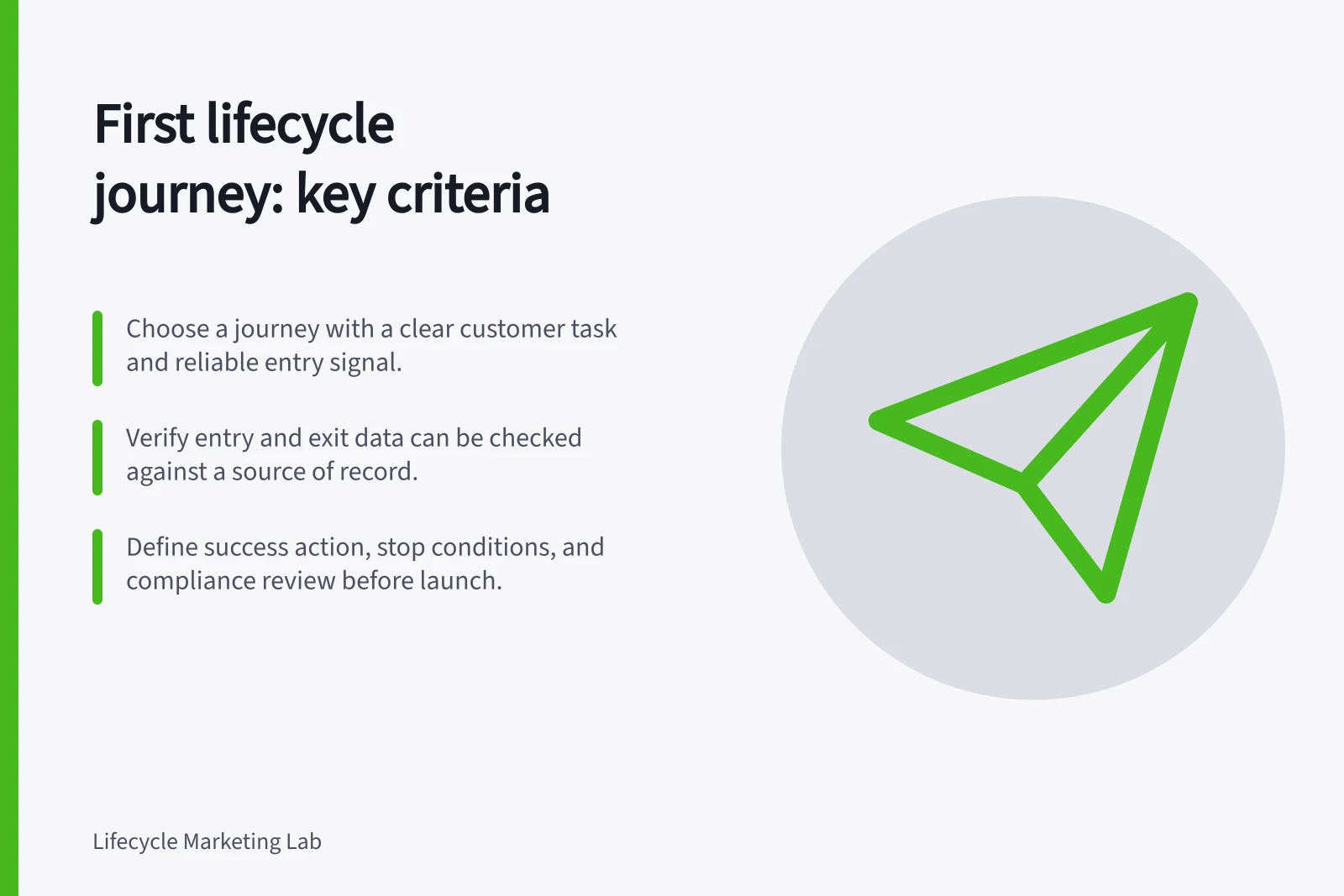
These are decision criteria, not a scoring model with universal weights. Uncertain purchase or support data may call for data work before messaging work. For each candidate, verify that its entry and exit data can be checked against a source of record.
Consider a hypothetical subscription service choosing among setup help, an upgrade offer and renewal reminders. If it records account creation and first successful use accurately, but plan-limit and renewal records are incomplete, setup help is the more reviewable initial project. A business with reliable contract dates and a clear account owner might instead choose a renewal process.
Write a short brief before building
State the customer task, eligible population, entry observation, proposed response, success action and stop conditions. Name the source of each field and the person who resolves a disputed record.
Include a case where the customer completes the task before the message and one where data is missing. If the team cannot say what happens in those cases, the journey is not ready to launch.
Keep the first version narrow: one entry reason and one useful next step may be enough. Add a second branch or channel when it addresses a distinct need that the team can support. Before launch, confirm that the proposed message has passed the organisation's applicable compliance review.
Review the path before release
Walk through representative histories: an eligible person, someone who already completed the task, an opted-out recipient, a late event and someone with an open service issue. Record the expected entry, send or skip, and exit. Inspect the configured workflow and other queues that could send a conflicting message.
Choose an outcome window and review date. Count eligible people as well as entries and deliveries, then inspect skips and wrong sends.
A messaging platform may record a conversion when a configured condition is met within its attribution window; that does not establish that the journey caused the result. Where feasible, use a suitable comparison to assess added value after the basic path works.
Metrics to track after launch
- Eligible people
- Count of users matching entry criteria
- Entries
- Number of times journey triggered
- Deliveries
- Number of messages sent successfully
- Skips
- Instances where journey did not send (e.g. already completed)
- Wrong sends
- Messages sent to ineligible or opted-out users