Onboarding Journeys
Customer milestone and expansion journeys
Plan customer milestone journeys that recognise progress, check upgrade relevance, protect support conversations and measure expansion fairly.
A customer milestone is a reason to recognise progress. It becomes an opening for expansion only when another product, service or level of capacity would help with a need the customer has shown. Confirm what happened, offer a useful next step, and make a commercial invitation only when it fits.
Choose milestones that mean something to the customer
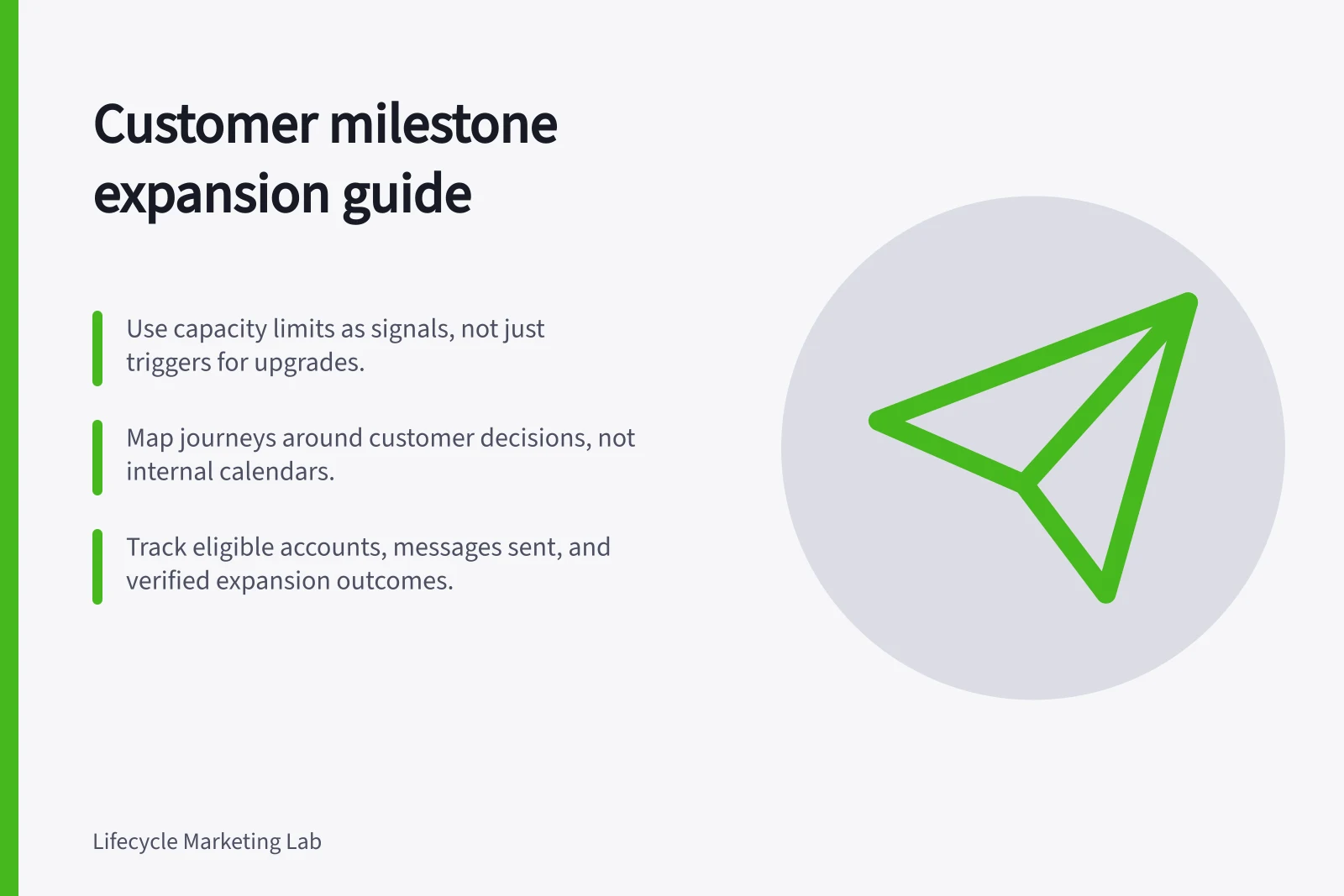
A milestone might be a first completed project, sustained use of a feature, a growing team or a repeat order. Its value depends on the customer’s goal. An account anniversary is easy to calculate but says little about upgrade need. Reaching a capacity limit may signal a need, or it may reflect a temporary spike or a problem with the current setup.
Map the journey around customer decisions
A journey map can connect milestones to the decisions customers make along the way. Retail Doctor Group describes mapping a set of customer personas’ interactions and purchasing decisions, from initial awareness through post-purchase experiences, to represent their needs, pain points and engagement.
Use the map to place each proposed message in context: what the customer has already done, what decision may come next, and where the offering could help. This makes it easier to distinguish a useful progression from a sequence that merely follows the business’s internal calendar.
Give each message one job
Recognition can confirm progress and show how to get more from the current purchase. Education can explain an unused capability. An expansion message can address a demonstrated constraint and explain the available options. A customer does not need to receive all three.
Suppose a project software team completes its first shared project. A note showing how to reuse the workflow fits that achievement. If the team later encounters a recorded member limit, an explanation of capacity options may be useful. Completing the project alone did not establish upgrade readiness.
Make the journey a series of decisions
Treat the journey as a series of decisions about whether a commercial message still fits recent behaviour and the customer’s situation. It is not a fixed internal calendar.
Define cohorts for consistent selection
A behavioural cohort groups people who share actions within a defined time window. Amplitude’s cohort guidance allows membership rules to combine event, property, propensity and group conditions; for journey planning, this offers a way to describe who qualifies rather than relying on a vague label such as “active customer”.
Choose a counting method that matches the milestone: a count of actions, a comparison of two action frequencies, a sum of a numerical property, distinct property values or a historical count. The chosen rule should express the progress being recognised, not simply make the qualifying group larger.
Protect customer care and sales conversations
Necessary service updates should continue through the appropriate service process.
If an account manager is negotiating an expansion, an automated offer may conflict with the proposal. Use a recorded handover state to withhold or review the commercial step while allowing useful product guidance where appropriate.
Set commercial guardrails around expansion
Scale Suite recommends concentrating on core revenue streams and reviewing sales data to align investment with demand. It also advises against diversification into unrelated areas, which can dilute focus and increase costs.
The SME growth guide from MicroChannel highlights maintaining quality while enabling growth. It identifies cash-flow improvement through stronger receivables, inventory management and accurate forecasting as business priorities.
Pros and Cons of Automated Expansion Messaging
- ProsScales support; enables timely recognition; aligns with customer progress; reduces manual effort.
- ConsMay conflict with sales teams; risks messaging at wrong time; can dilute focus if used across unrelated products.
Measure the contribution fairly
Count accounts assessed for the journey, those eligible, those excluded, messages delivered and verified expansion outcomes. Report self-serve changes separately from deals already led by sales. Attribution reports alone do not show that a message caused the purchase.
Set the outcome window and revenue basis before reporting. Review misfires alongside conversions, including messages sent after an upgrade, during an open issue or after a sales handover.
Where a suitable comparison is possible, an account-level holdout can help estimate impact. Keep necessary service communication available to both groups.
Start with a milestone whose meaning can be checked against customer histories, including accounts that reached it without needing more capacity.
Key Metrics for Measuring Milestone Journeys
- Accounts assessed
- Total number of accounts considered for the journey
- Messages delivered
- Count of automated messages sent at milestone points
- Verified expansion outcomes
- Upgrades or expansions confirmed post-message
Evaluate the next step against customer value
Before making an expansion invitation, compare the proposed option with the customer’s mapped needs and the progress that prompted the conversation. A next step is more defensible when it addresses a customer decision or pain point than when it simply promotes a broader range of products.
In this guide
- Identifying a genuine readiness signal for an upgradeDistinguish a meaningful upgrade need from weak activity signals using customer tasks, constraints, intent and a review of false positives.
- Triggering messages after a customer reaches a milestoneDefine a reliable milestone event, prevent duplicate entry and recheck customer context before each scheduled message.
- Avoiding upsell messages during an unresolved support issuePause commercial messages when relevant support issues are unresolved, then reassess the offer before any journey resumes.
- Measuring expansion journeys separately from sales-led dealsSeparate journey-eligible accounts, sales-owned deals and shared handovers before reporting expansion revenue or estimating impact.