Onboarding Journeys
First-purchase lifecycle journeys
Build a first-purchase journey from signup and buying signals, then stop prospect messages when an order is placed.
A first-purchase journey moves an eligible new subscriber from initial interest to a confident buying decision. Build it around four decisions: which event starts it, what path follows, what stops it on purchase, and how incremental value is measured. It stops asking for a first order once one exists. Build it from observable events: signup, product interest, checkout start and placed order. The rules that keep each message timely and appropriate matter more than the sequence.
Start with the entry reason
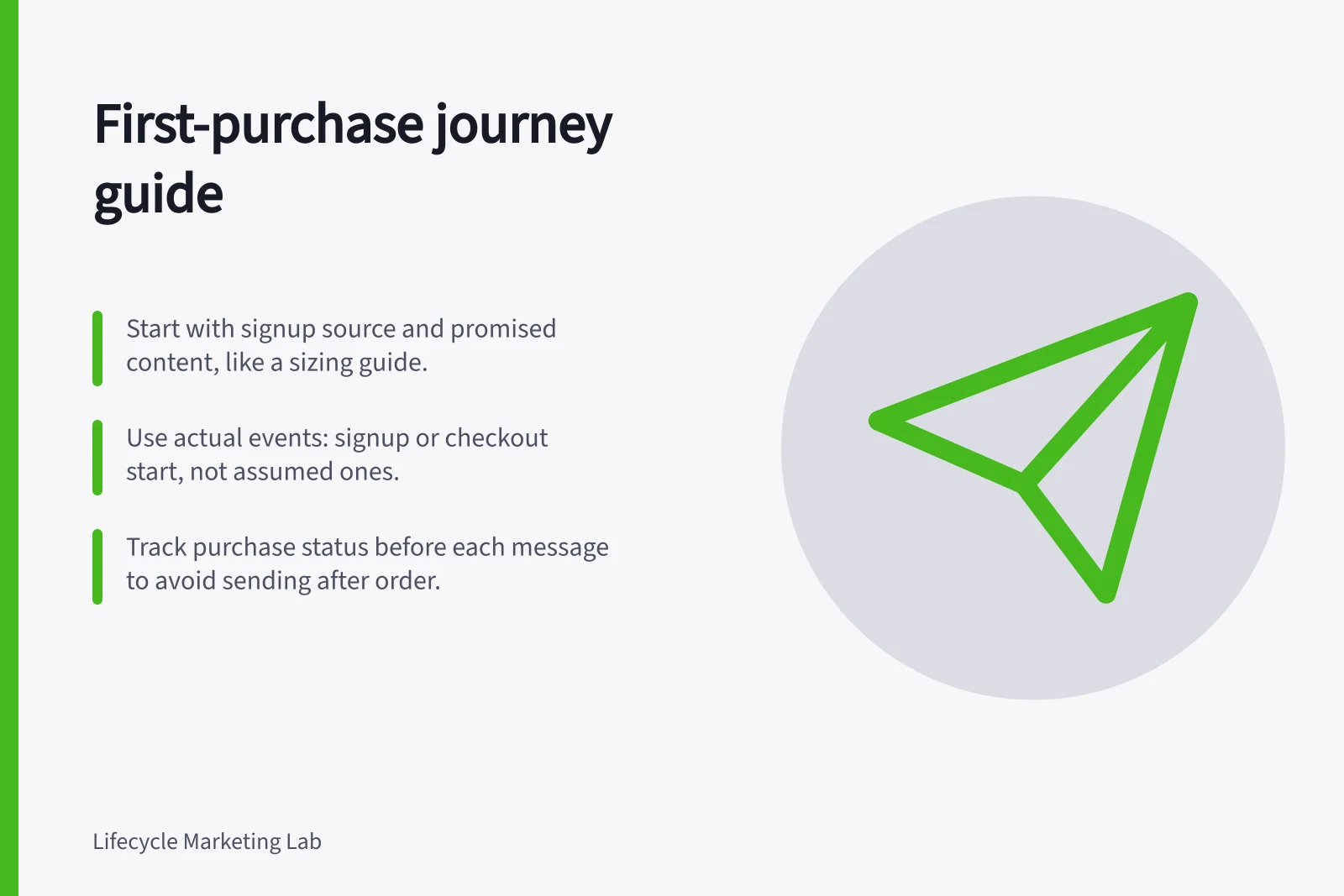
Someone who signs up for a product guide has a different immediate question from someone who starts checkout and stops. Record the signup source and what the person expected to receive. The first message should fulfil that promise before any generic sales offer. If the form promised a sizing guide, deliver the guide and help the reader use it.
Choose a small number of steps with distinct jobs. One may explain product fit, another address setup or delivery questions, and a later one may present a relevant offer if the person has not bought. Do not send several near-identical reminders. Klaviyo provides a pre-built welcome series and a flow library with further ideas.
Klaviyo's welcome-series example sends an email immediately, then automates 2 or 3 other emails, each a few days apart. Use the timing alongside distinct message jobs so the sequence remains relevant to the entry reason.
A list-triggered welcome series needs to be connected to the list new subscribers join. Klaviyo lists sign-up forms, subscribe pages, manual additions, and the Lists API or Subscribe API as ways contacts can be added to a list.
Keep email and SMS welcome series separate. People may subscribe to each channel at different times, and a subscriber can enter a welcome flow only once.
If you import contacts into a live welcome series, set the flow to Manual first. Otherwise, imported contacts may be queued for the first message even if they subscribed months earlier. After the import, return the flow to Live.
Email vs SMS Welcome Series: Key Differences
- Channel-specific entrySubscribers may join email and SMS at different times
- Single entry per flowA subscriber enters a welcome flow only once, regardless of channel
- Separate flows requiredKeep email and SMS welcome series independent for timing and content control
- Import handlingSet flow to Manual when importing contacts to avoid sending messages to past subscribers
Use the right event for the right path
Signup and checkout start are distinct entry events. Choose the event that matches the path you are building.
Use the actual event your system records. Klaviyo's examples include the Started Checkout event and an event for placing an order; do not assume every store or platform uses the same event names.
Map the journey as a simple decision path:
- Has the person agreed to receive the relevant marketing message?
- What event brought them in, and what was promised?
- Has an order been placed since that event?
- Is there another active journey that would send a conflicting message?
- What single next step would help now?
Consent status comes before content selection. A behavioural trigger does not settle marketing permission. Treat order and suppression data as time-sensitive: a delayed sync can send a prospect message to a buyer.
Trigger filters narrow who qualifies based on the event, such as limiting an order-triggered flow to particular product types. Profile filters are broader eligibility checks: they apply when someone enters and again before each email, so someone who no longer qualifies can be kept from continuing.
Stop or change course after purchase
Recheck purchase status before each scheduled message, not only on entry. Profile filters can help skip a later welcome email when the person has already purchased; see the sibling article on suppressing an offer after purchase for detailed setup.
Measure incremental value
Choose a conversion event and window before launch. Platform dashboards can report attributed revenue and conversions; Klaviyo's flow analytics does so by selected metric. Attribution is not the same as proof that the journey caused every order.
For coupon-bias evaluation, track uptake and whether buyers who would have purchased anyway received the discount. A holdout or carefully designed comparison can help estimate incremental value where feasible; see the sibling article on evaluating first-purchase journeys without coupon bias for detailed treatment.
Klaviyo flow analytics defaults to the last 30 days and offers views for the last 7 days, 30 days, 90 days, 12 months or a custom range of up to 366 days. You can compare a selected period with the previous period or the same period last year.
Review misfires as well as totals: messages sent after purchase, repeated incentives, wrong checkout links and unsubscribes. Flow dashboards can be viewed by channel or by flow, with period comparisons.
First-Purchase Journey Performance Metrics
- Attributed Revenue
- Available via Klaviyo Flow Analytics or platform dashboards
- Conversion Window
- Default: last 30 days; custom range up to 366 days available
- Period Comparison
- Compare current period with previous period or same period last year
- Misfire Review Focus
- Track messages sent post-purchase, repeated incentives, wrong links, unsubscribes
Pros and Cons of Using Coupon Incentives in First-Purchase Journeys
- ProsCan boost initial conversion rates; useful for new customer acquisition
- ConsMay attract price-sensitive buyers who wouldn’t have purchased otherwise; hard to measure true incremental value
- MitigationUse holdout groups or A/B testing to estimate real impact without bias
In this guide
- Connecting signup intent to a first-purchase messageThe first purchase-oriented message should follow the reason a person signed up.
- Suppressing an offer after a customer has already boughtCheck for a completed order immediately before a first-purchase offer is sent, and skip or replace the offer when one exists.
- Handling abandoned account creation separately from abandoned checkoutAn abandoned account setup and an abandoned checkout indicate different unfinished tasks.
- Evaluating first-purchase journeys without coupon biasEvaluate a first-purchase journey by asking whether it helps eligible people buy, and at what incentive cost.