Renewal Journeys
Part of Lifecycle programme governance
Deciding when a lifecycle journey should be retired
Assess whether a lifecycle journey still serves a customer need and plan the exit for new and active customers.
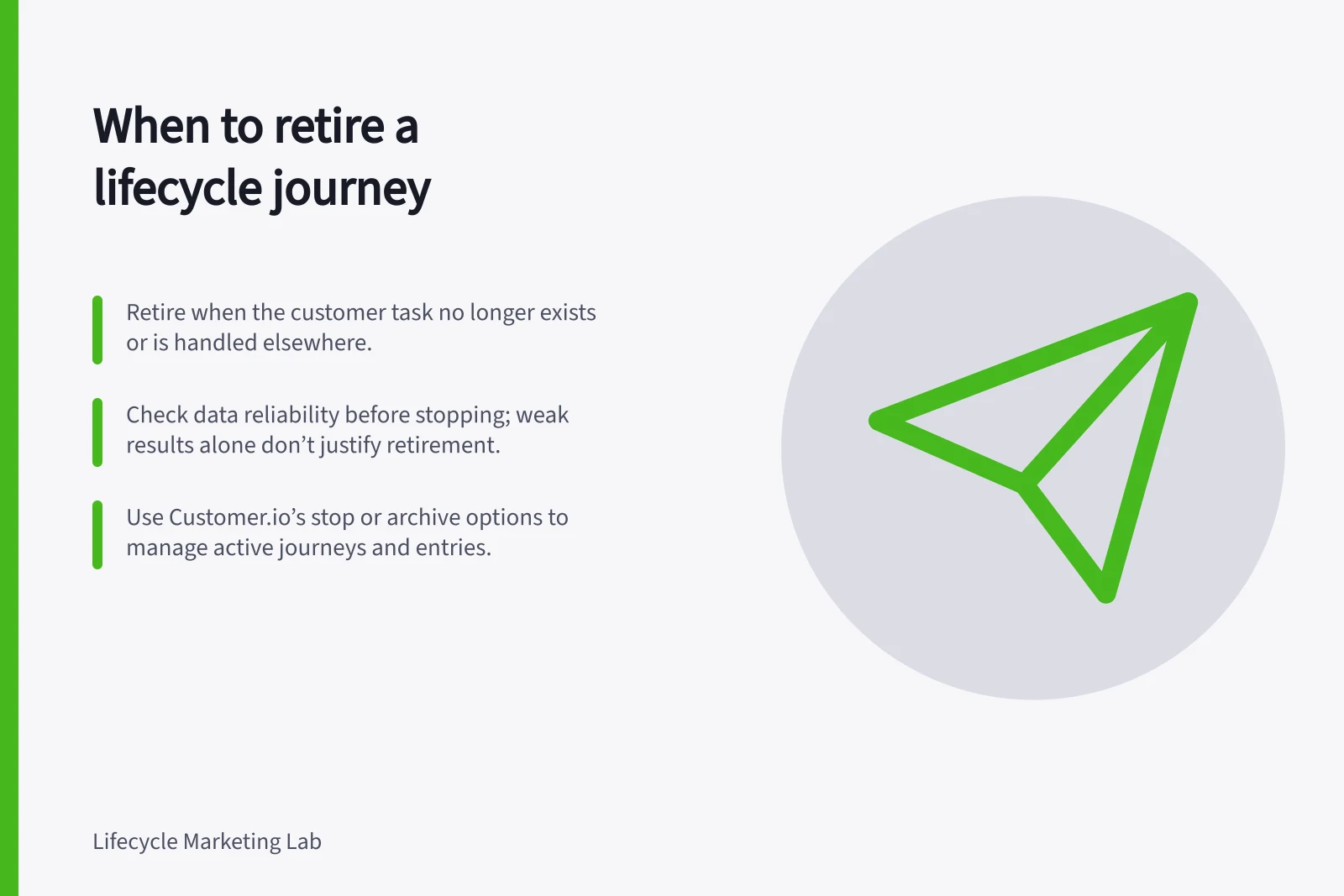
Retire a lifecycle journey when its customer task has ended, the message cannot be made accurate and useful, or continued operation is no longer justified under an agreed decision rule. Low entry or a weak dashboard result alone is insufficient: the feed may be broken, the audience may be seasonal, or the outcome may be measured poorly. Establish the reason before choosing an exit for people already in the path.
Decide whether the job still exists
Write the journey's original job in one sentence. Has the product step disappeared? Has another process taken over the customer question?
Are the offer or terms still available? Can the source event still identify the intended situation? If the customer need remains but one rule or message is stale, revision may be the better decision.
Finding / Decision to examine
- Customer task ended or moved to another process
- Retire and identify the replacement route.
- Task remains, but entry data is unreliable
- Hold affected sends and repair the evidence.
- Accurate response is now redundant
- Remove or combine the path after reviewing customer impact.
- Reported outcome is weak or uncertain
- Check measurement and suitable comparisons before judging value.
- A materially wrong send is possible now
- Hold the affected step while its owner decides what follows.
The journey owner should review the evidence with the relevant data, service or sales owners.
Plan the customer exit
Identify future entrants, people already waiting, drafted or queued messages and customers needing a human or service handover. Decide what each group should receive. A necessary account update should not disappear simply because a marketing path is retired.
Check related campaigns, sales sequences, in-product prompts and reports. Stopping one automation does not stop every other queue carrying the same claim. Preserve the outcome definition and the period the journey operated so earlier reports remain interpretable.
In Customer.io, stopping an automation prevents new entry and offers a choice between letting active journeys finish and forcing immediate exit. Archiving makes the automation inactive, so customers cannot enter; it cannot be edited until unarchived.
Email and SMS already marked sent through external providers may still arrive after an immediate stop. Check the behaviour of other platforms separately.
Record and verify the decision
Keep a retirement note with the journey ID, customer task, evidence, decision owner, effective date, active-customer treatment, replacement route and remaining communication needs. State why retirement was chosen over revision or a temporary hold. If evidence is incomplete, name the missing fact and set a review date.
If performance matters to the decision, use the outcome the journey was meant to support. Fewer sends or attributed conversions do not establish that the journey stopped helping. Interpret an experiment only for its tested audience, intervention and period.
After the agreed stop, check that new customers cannot enter, active customers followed the approved exit route and other queues no longer carry obsolete claims. Keep the decision record so the closure can be distinguished from a forgotten journey.