Onboarding Journeys
Part of Lifecycle content mapping
Matching the next message to a customer's current question
Use current evidence to choose a message that answers one likely customer question without assuming an unverified motive or task status.
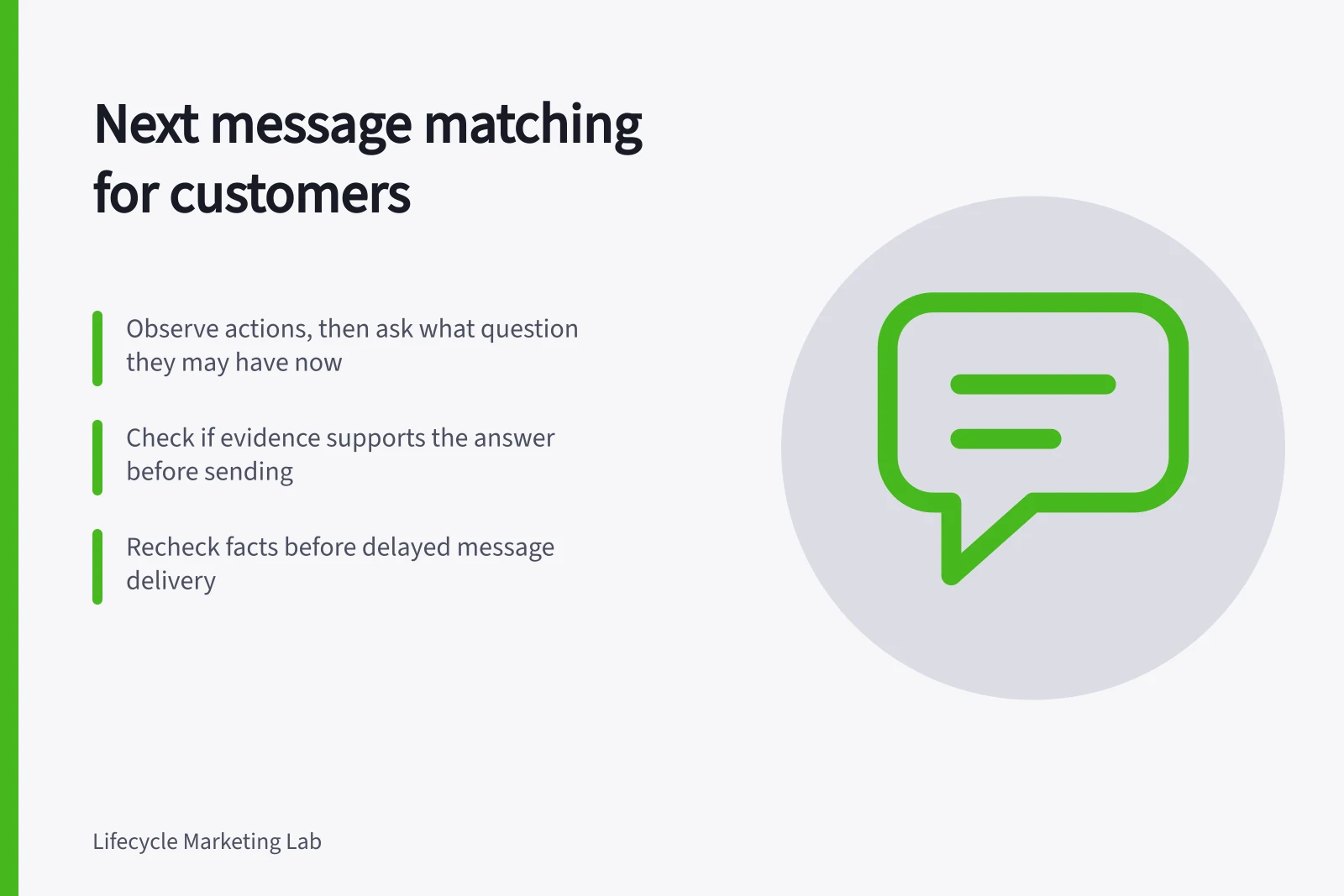
Choose the next message by identifying the question the customer may have now, then checking whether the available evidence supports the answer. If several questions remain possible, ask, offer a choice or provide neutral help. Do not write as though a behaviour proves a motive it cannot reveal.
Separate the observation from the question
A customer who opens plan details may want to compare options, confirm what they already have or investigate a limit. The observation supports a broad topic; it does not establish which answer they need. A failed upload event may support specific troubleshooting if the error and current task are known.
For each proposed message, write two sentences in the brief: ‘We observed…’ and ‘The customer may be asking…’. If the second does not follow safely from the first, seek another signal or make the message less specific.
| What is known | Safe next content decision | Claim to avoid |
|---|---|---|
| Plan page viewed | Help compare current options | ‘You are ready to upgrade’ |
| Task failed with a known error | Explain that error or offer help | ‘You have never completed this task’ |
| First task completed | Offer a relevant next step | ‘Your whole team is fully set up’ |
| No task status received | Hold a status-specific message or offer general help | ‘You have not started’ |
These situations are illustrative. Check what the organisation’s events actually record.
Choose the answer and action together
A useful message resolves one question and gives one workable next step. A customer stuck on an import needs a fix or a route to support. A broad feature tour is unlikely to answer the immediate problem. If a person is already handling it, the next response may be a handover.
Check the answer against the customer’s current access, product version and earlier messages. An instruction can be correct yet unnecessary if the customer has already acted. Set a condition that makes the message expire, such as task completion, a changed plan or a later service update.
Decide again before a delayed send
The question may change while a message waits. Recheck the facts that justify its wording close to dispatch.
In Customer.io, a configured action condition is checked before the action starts. If the condition fails, that action is skipped and the person continues through the automation. Inspect the actual configuration and any other queue that could send the same answer.
For commercial email or SMS in Australia, also check recipient consent, sender identification and contact details, and the unsubscribe facility. Relevance does not replace permission.
Review proposed customer histories before release, including a quick completion, a failed attempt, a late event and an unknown state. The right next message may be no message.
Key Compliance and Messaging Guidelines for Australian Commercial Messaging
- ACMA Spam Rules
- Must include clear unsubscribe mechanism
- Sender Identification
- Use verified sender name and number/email
- Consent Requirement
- Messages must only go to recipients who consented
- Message Relevance
- Does not override need for permission