Renewal Journeys
Renewal communication journeys
Build a renewal journey around contract dates, decision states and account roles, with clear rules for reminders, negotiations and stopping outreach.
A renewal journey helps the right people make a contract decision in time, then stops asking once the outcome is known. Build it around the agreement's terms and dates.
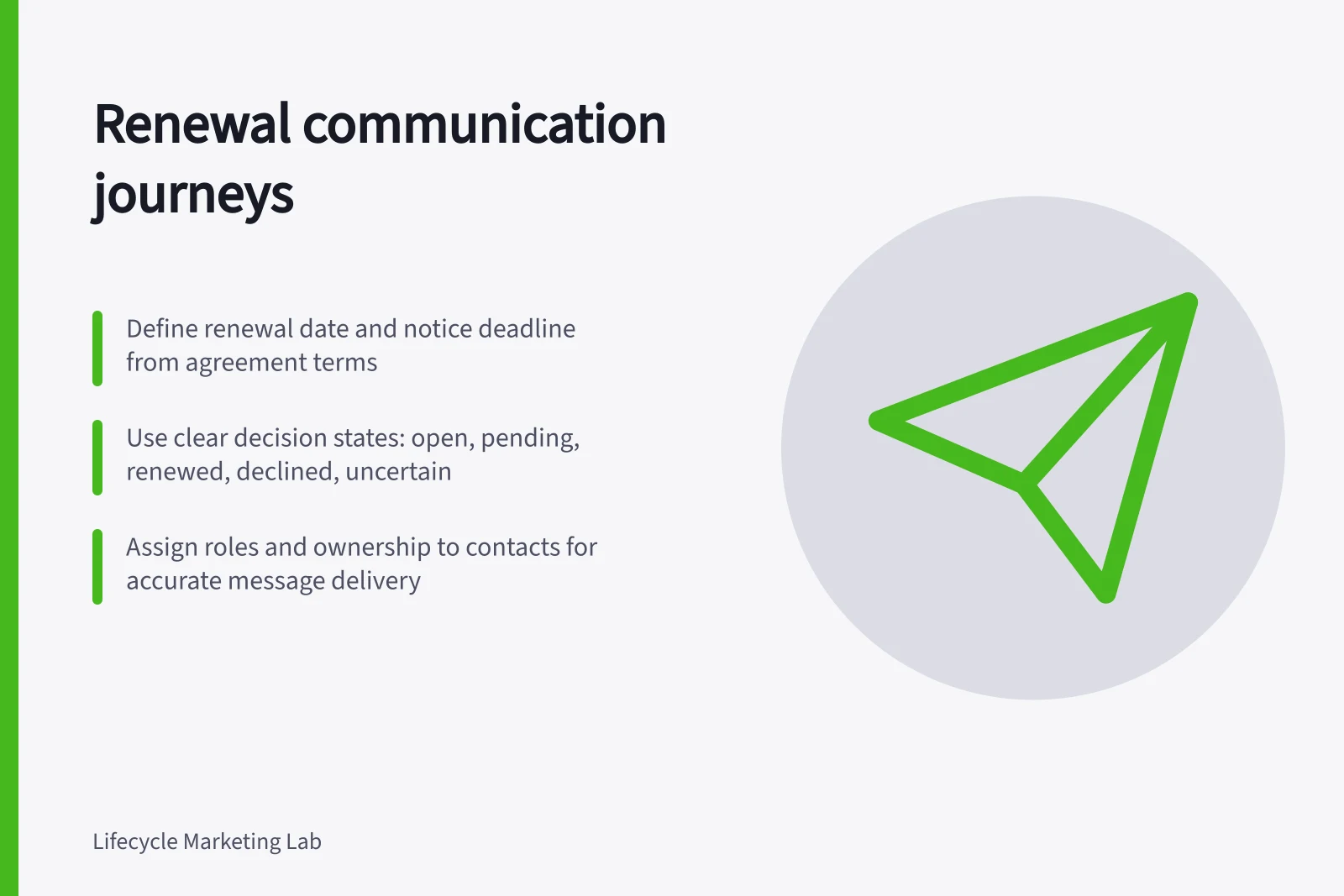
The essential inputs are the renewal date, any earlier notice deadline, the decision state, the account owner and the contacts who need particular information.
Start with the agreement
Before scheduling a message, confirm what happens at the end of the term. Does renewal require an active decision, happen automatically, or depend on notice by a particular date?
Check the current signed terms and amendments. A CRM close date or billing date may serve another purpose; ask the contract owner to resolve discrepancies.
Keep the dates distinct. If notice must be given before renewal, explain the verified deadline while there is still time to act.
If the terms or date are disputed, hold automated claims about them for review.
Give each step one job
| Step | Reader question | Appropriate response |
|---|---|---|
| Early preparation | What is coming up, and who needs to take part? | Confirm relevant dates and a route for questions. |
| Decision period | What are the options under this agreement? | Provide approved information or connect the customer with the person handling terms. |
| After a decision | What happens next? | Confirm the recorded outcome and any remaining steps. |
This is a planning model, not a universal timetable. Work backwards from the earliest meaningful deadline and allow for the customer's approval process.
Avoid inventing a response date to create urgency.
Keep account information separate from proposals and retention offers. Make the purpose of each message clear and review it before sending.
Let the decision control the journey
Define states that distinguish an open discussion, a pending decision, a verified renewal, a decline and an uncertain record. Name the system and person authorised to change each state.
A booked meeting or verbal indication does not necessarily establish a completed renewal.
Check the current state near dispatch and review waiting messages when it changes. After a verified renewal, replace the old request with an appropriate confirmation or handover.
After a decline, stop appeals that assume the decision is still open. Hold uncertain cases for the account owner. Decide separately which necessary account communications should continue.
Pros and Cons of Automated Renewal Reminders
- ProsEnsures timely communication; reduces manual follow-up; supports compliance with notice periods.
- ConsRisk of spam if not stopped after decision; may conflict with live negotiations; can mislead if state is not updated.
Address the right contacts
A service lead may need continuity details, procurement may need approved commercial terms, and an authorised signatory may need the final document. Record roles against the particular agreement.
A shared employer or job title alone does not establish authority to receive contract details.
Give the negotiation a named owner so automated messages cannot contradict a live proposal. Share the agreement's decision state across contact journeys while checking each recipient's current role and eligibility.
Review the journey
For each renewal group, track eligible agreements, messages held or sent, decisions recorded before the relevant deadline, and messages delivered after a decision. Investigate the last group for stale dates, delayed updates or missed queues.
Assess sales-led conversations separately from automated outreach; a renewal after an email was delivered does not show that the email caused it.
Begin with agreements whose dates, owners and contact roles are reliable. Review examples involving an early decision, an amended date, an active negotiation and a decline before extending the journey.
Key Renewal Metrics to Track
- Eligible agreements
- Total contracts due for renewal within the review window.
- Messages sent before deadline
- Number of pre-decision communications delivered.
- Decisions recorded on time
- Percentage of renewals finalised by the required notice date.
- Post-decision messages sent
- Instances where outreach continued after a renewal was confirmed.
In this guide
- Working backwards from a renewal datePlan renewal messages from the agreement’s real deadlines, account tasks and time zone, then update the schedule when contract dates change.
- Separating reminder messages from renewal negotiationsKeep renewal process notices aligned with live negotiations using clear message purposes, a named owner and a recorded handover state.
- Pausing renewal outreach after a contract decisionDefine a verified contract decision, review queued renewal requests and check other channels before outdated outreach reaches the customer.
- Coordinating renewal messages across account contactsMap renewal roles to a specific agreement, share one decision state and check each contact’s need and eligibility before sending.