Lifecycle Experiments
Part of Lifecycle content mapping
Building reusable message modules for journey stages
Define reusable message modules with a clear purpose, current facts, allowed contexts, fallbacks and a review process for every channel version.
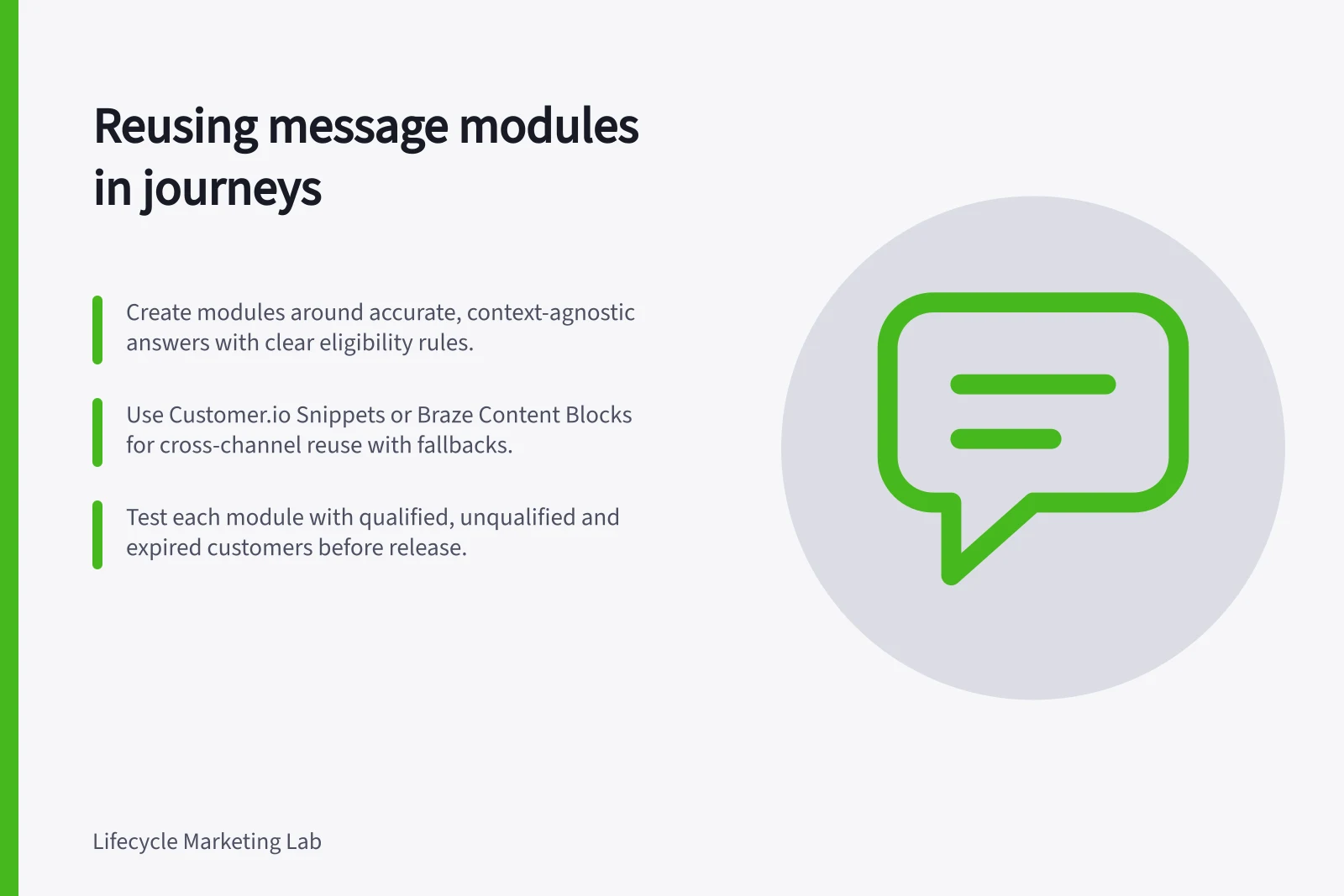
Build each reusable module around an answer that remains accurate in every approved context. Keep its purpose, facts and eligibility rules together. Let the surrounding message supply the channel-specific introduction and next action. Reusing a paragraph without those boundaries can spread an outdated claim.
Decide what deserves reuse
Candidates include an approved feature explanation, an instruction used in several journeys or an offer description with its conditions. A greeting tied to one moment, a deadline or a claim about individual progress usually needs more context than a standalone module provides.
Give each module a short specification:
- Purpose:
- the question it answers.
- Required facts:
- product version, eligibility, locale or terms that must be current.
- Allowed contexts:
- stages and channels where the answer fits.
- Variables and fallbacks:
- what appears when a customer field is absent.
- Expiry and owner:
- who reviews the module when a dependency changes.
Separate the core from the wrapper
Imagine a hypothetical service with an approved explanation of how to add a teammate. The core module can explain the action and its access requirement. An onboarding email may introduce it as a first shared step; an in-product prompt may use a shorter label beside the control. An expansion email should not reuse the onboarding introduction just because the action has the same name.
Write each channel version for its available space and action. When shortening for SMS, check that the full instruction still makes sense without its surrounding explanation.
Check how reuse works in the actual tool
Customer.io Snippets can be used wherever Liquid is supported, including email bodies and text messages. Its documentation advises a fallback when profile data may be missing and a snippet is also used in anonymous messages. Braze Content Blocks provide a central place to manage reusable, cross-channel content; its documentation describes drag-and-drop and HTML block types.
Record whether each use is linked or copied, and inspect the complete rendered message after a shared edit. A preview of the module alone cannot show how every surrounding message reads.
Reusable content tools: Customer.io vs Braze
- Tool
- Customer.io Snippets
- Supported in
- Email bodies, text messages (where Liquid is supported)
- Fallback recommendation
- Use when profile data may be missing or in anonymous messages
- Tool
- Braze Content Blocks
- Management approach
- Centralised, drag-and-drop interface with HTML block types
Release a module with examples
Before approval, review a customer who meets the module’s conditions, one who lacks a required field and one who no longer qualifies. Read the complete email, SMS or product message in each case.
Record which journeys use the module and who owns local adaptations. If a change alters the meaning, review every dependent message.