Onboarding Journeys
Part of Designing customer onboarding journeys
Removing competing messages from an onboarding sequence
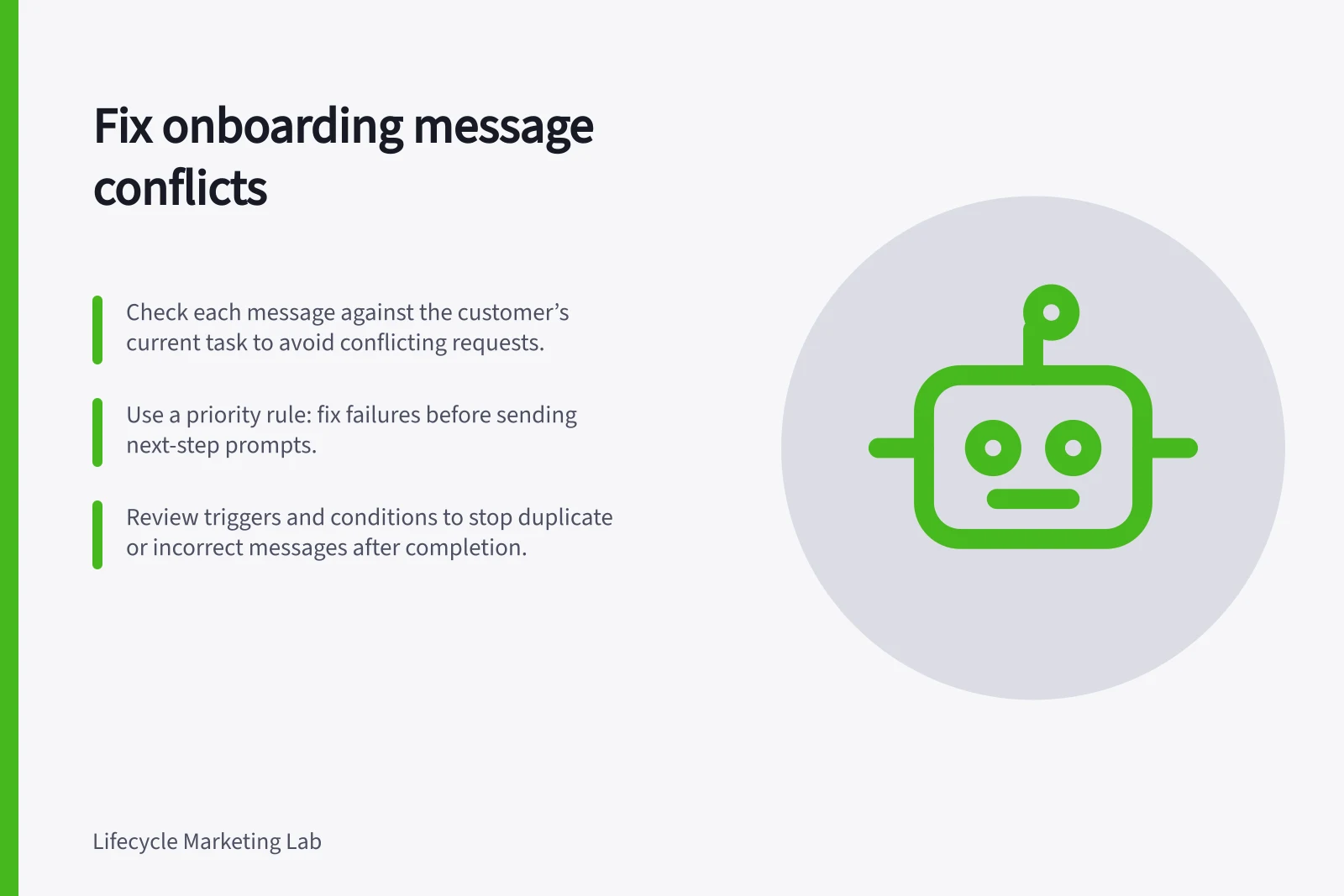
Audit onboarding messages for repeated or contradictory requests, set a priority for each customer situation and correct the send rules.
Give each onboarding step one customer purpose, then check every scheduled request against the customer’s current task. Messages can conflict even on different days: one assumes a task is unfinished, another assumes it is complete.
Inventory the sequence
Put the welcome email, in-product prompts, tutorials and reminders for this onboarding task on one page. Include messages scheduled by other teams for the same task. For each, record its trigger, customer purpose, main request and cancellation rule.
Read the sequence from the customer’s point of view. Mark messages that repeat a request after completion, give different instructions for the same step, ask for unrelated actions at once or assume progress that has not been confirmed. Remove a message whose job is already covered, or move its useful instruction into the stronger step.
Set a priority for each situation
Suppose a customer in a hypothetical workspace is asked to create a project, then reports that project creation failed. A waiting invitation to add colleagues assumes the project is ready. Address the failure first; invite colleagues once there is a usable project.
| Current situation | Keep | Hold or remove |
|---|---|---|
| First task unstarted | One clear starting prompt | Advanced tips that assume completion |
| First task failed | Help with the obstacle | Repeated generic reminders |
| First task confirmed | A relevant next step, if any | Instructions for the finished task |
| Status uncertain | Cautious help or review | Claims that the task is complete or incomplete |
This priority covers messages serving one onboarding task. Conflicts between different lifecycle journeys need a wider coordination rule.
Fix the send rules
Editing copy will not cancel a reminder waiting after task completion. Review triggers, delays, message conditions, exits and other queues. Put a current check near each delayed send and decide whether a failed check should skip one message or end the path.
In Customer.io, action conditions can skip an action while a person continues through an automation. Exit conditions are separate and depend on the configured criteria and trigger type.
Customer.io message frequency limits apply only after the relevant workspace limit and workflow or message assignment are set; by default they do not apply to messages. A frequency limit also cannot decide which of two requests is appropriate. Check the organisation’s actual configuration and other sending systems.
Key Messaging Rules and Limits (Customer.io)
- Action conditionsCan skip an action while continuing through automation.
- Exit conditionsIndependent of action conditions; depend on configured criteria and trigger type.
- Message frequency limitsApply only after workspace and workflow settings are configured; default is no limit.
- Spam compliance (Australia)Follow ACMA guidelines to avoid sending spam; ensure opt-in consent and clear unsubscribe options.
Check the revised path
Trace example histories for immediate completion, a step finished during a delay, a failed attempt and a late completion event. List the messages each person should receive or skip, then inspect the configured workflow and relevant queues before release.
After launch, review delivered messages for contradictory instructions and prompts sent after completion.