Lifecycle Segmentation
Customer events and lifecycle segmentation
Define reliable customer events, build lifecycle segments around clear decisions and check changing membership before sending messages.
Customer events help define lifecycle segments when they record a meaningful change in a customer's situation. Start with the decision the segment will support, define the evidence for joining and leaving it, and check that evidence before acting.
A label such as “active customers” is only useful once the team agrees what activity counts, for whom and over what period.
Give events and segments different jobs
An event records an action or outcome, such as an account being created or a task being completed. A segment groups people or accounts that meet a rule. That rule may combine events, current attributes and time limits.
A lifecycle stage describes progress under a chosen definition; it does not, by itself, establish whether a message should be sent.
| Record | What it can show | What it cannot establish alone |
|---|---|---|
| Account created | Access was created | The customer used the service |
| First task completed | A defined task finished | The wider problem was solved |
| Recent use | A qualifying action was recorded in a chosen period | Future use |
| Current plan | The arrangement recorded now | Readiness to upgrade |
Choose events that fit the product and the customer's task. Keep a historical milestone, such as first completion, separate from a changing state, such as use in the past month.
Define the evidence
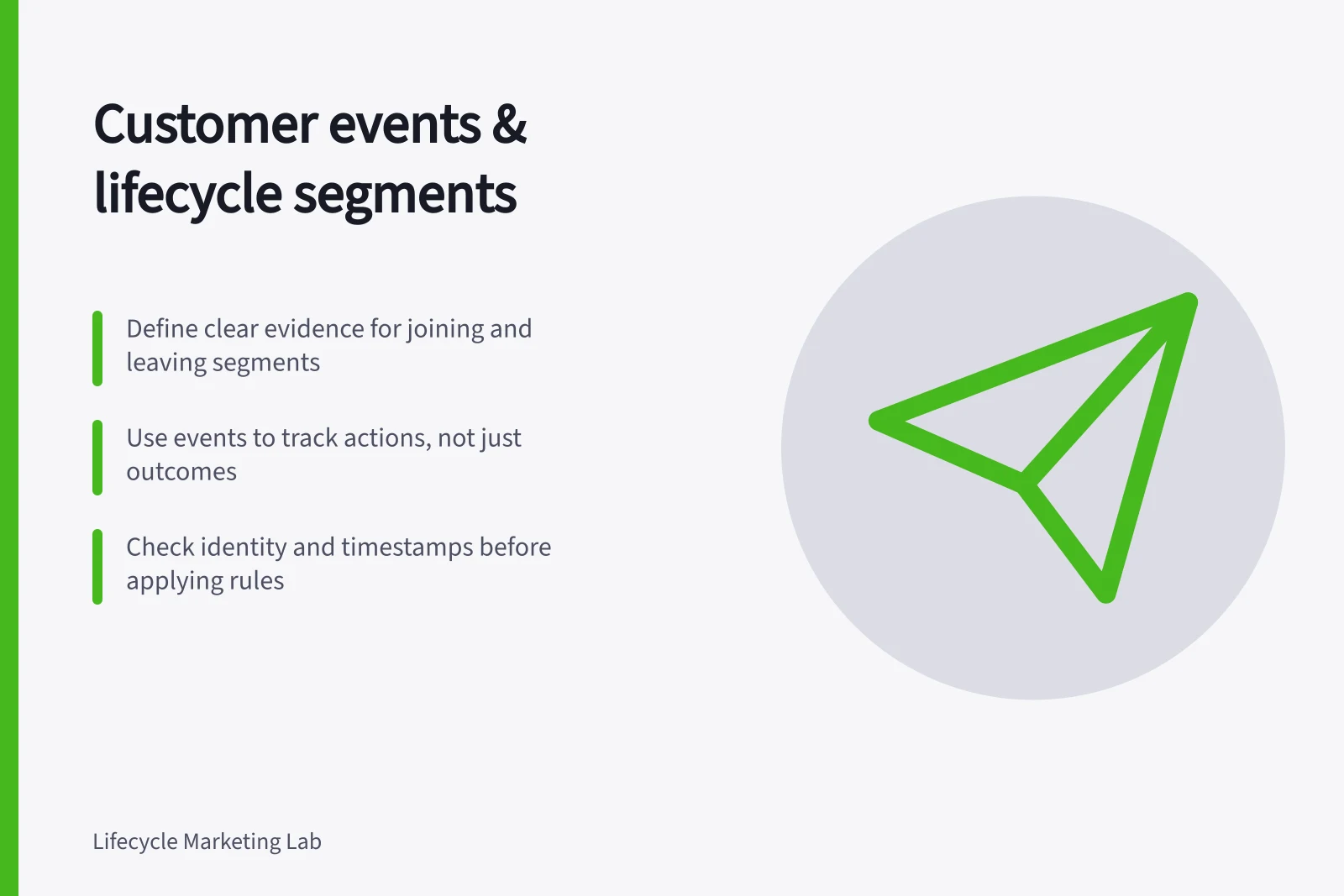
For each event that can change a segment, document its name, source system, person or account identifier, occurrence time, required properties and valid outcome. Decide whether an attempt or only a confirmed result counts. Task Submitted and Task Completed may justify different responses.
Record when an action occurred and when the segmentation system received it. Late arrivals can make an old action look new if a rule relies on receipt time. Check the quality of timestamps, along with duplicates, corrections and work completed outside the product.
If several people use one account, specify whether the rule applies to a person or the account.
A tracking plan can document expected names and properties. Compare sample customer histories with the definition as well: the plan alone cannot show whether an event fires at the right point in the task.
A Track event has a name and may include properties describing the action. Specify the expected property names and data types as well as the event name, so records with inconsistent values can be identified instead of silently treated as equivalent.
A tracking plan can validate expected events against live events. Review violations when an event does not match its specification; if a property arrives with several data types, Segment cannot infer one reliable type for it.
Confirm that the destinations receiving events accept the fields your rule depends on, because not all destinations accept every common field.
Key Metrics for Lifecycle Segmentation Success
- Timestamp Consistency
- Less than 5% of events with out-of-range or missing timestamps
- Destination Field Acceptance
- All critical fields supported by primary messaging destinations
Resolve identity before applying a rule
An event needs an identity that matches the level of the segment. In Twilio Segment’s Track specification, userId identifies the user performing an action, while anonymousId can identify an otherwise unknown user and tie an event to them. Decide how anonymous activity will be treated when the person later becomes known; do not assume an event belongs to a customer until the identity has been resolved.
For account-level rules, keep the account identifier distinct from the person identifier. Segment’s common fields include groupId, while Track events can also carry user identifiers and event properties. Check that the identifier arriving with each event is the one the rule expects, especially when several people act on one account.
Write a rule for one decision
State who qualifies, who should be excluded and when membership must be recalculated. For example, a setup prompt might target recently created accounts with no confirmed first task, while excluding accounts with an open setup issue. The time window and issue definition must come from that business's own process.
Treat missing data as unknown. No completion event received does not always mean the customer failed to complete the task. A feed may be delayed, the work may have happened offline or the identity may not have joined correctly. If the distinction changes the message, hold it or use wording that does not claim failure.
Keep stage, customer characteristics and contact eligibility separate. A customer can be getting started, belong to an industry segment and still be ineligible for a marketing message. For commercial email or SMS, consult applicable Australian spam guidance before sending. An event does not establish permission to send.
Choose how membership is maintained
A data-driven segment can add people when they meet its conditions and remove them when they stop meeting them. This suits rules that must respond to incoming attributes or behaviour. A manual segment changes only when people are explicitly added or removed, which can suit membership governed by business logic outside the data system.
People can belong to more than one segment, so overlapping membership is possible. Write each rule so its criteria can be checked independently, and confirm whether it is intended to describe a person or an account. A segment may combine attributes and events; keep the conditions clear enough to identify which incoming record changes membership.
Manual vs Data-Driven Segment Membership: Pros and Cons
- Data-Driven MembershipAutomatically adds/removes users based on real-time conditions. Best for dynamic behaviour-based rules.
- Manual MembershipOnly changed via explicit actions. Suitable for business logic not tied to real-time data.
Check membership before acting
Membership can change during a journey delay. Recheck the relevant conditions near each scheduled action and decide whether to send, skip, change course or exit. Leaving a segment does not necessarily cancel queued messages: that depends on the workflow's configured conditions, and another sending system may have its own queue.
Preserve genuine milestones even when current needs change. A first completed task remains a historical fact after use stops; a reopened task may require a different response. A mistaken completion event, however, must no longer support the milestone. Keep the correction and its reason visible.
Before using a rule, review histories with immediate completion, a failed attempt, a duplicate, a late arrival, an offline completion and a reopened issue. For each, record the expected segment and response, then inspect the configured behaviour with suitable records. After launch, review wrong sends and missed customers alongside segment entries and exits.
When setting up a tracking plan, Segment can import events and traits that a source received over a selected recent period. Use those records to spot naming or property mismatches before relying on the rule.
When a condition is based on recent activity, confirm that the segment system is receiving the relevant event and identity fields, not merely that the event exists in the tracking plan. A missing or mismatched field can leave an otherwise active customer outside the intended segment.
In this guide
- Defining activation events that indicate real progressChoose an activation event tied to a customer's first meaningful result, specify it precisely and check what it says about progress.
- Separating lifecycle stage from demographic segmentKeep lifecycle progress distinct from demographic and organisation traits, then combine fields only when each helps a clear decision.
- Handling customers who move backwards in a journeyHandle reversals and corrected events by preserving history, updating current state and reviewing queued journey messages.