Lifecycle Segmentation
Identifying trial users who have not reached value
Classify trial users with an unconfirmed useful result, separating no attempt, failed attempts and uncertain data.
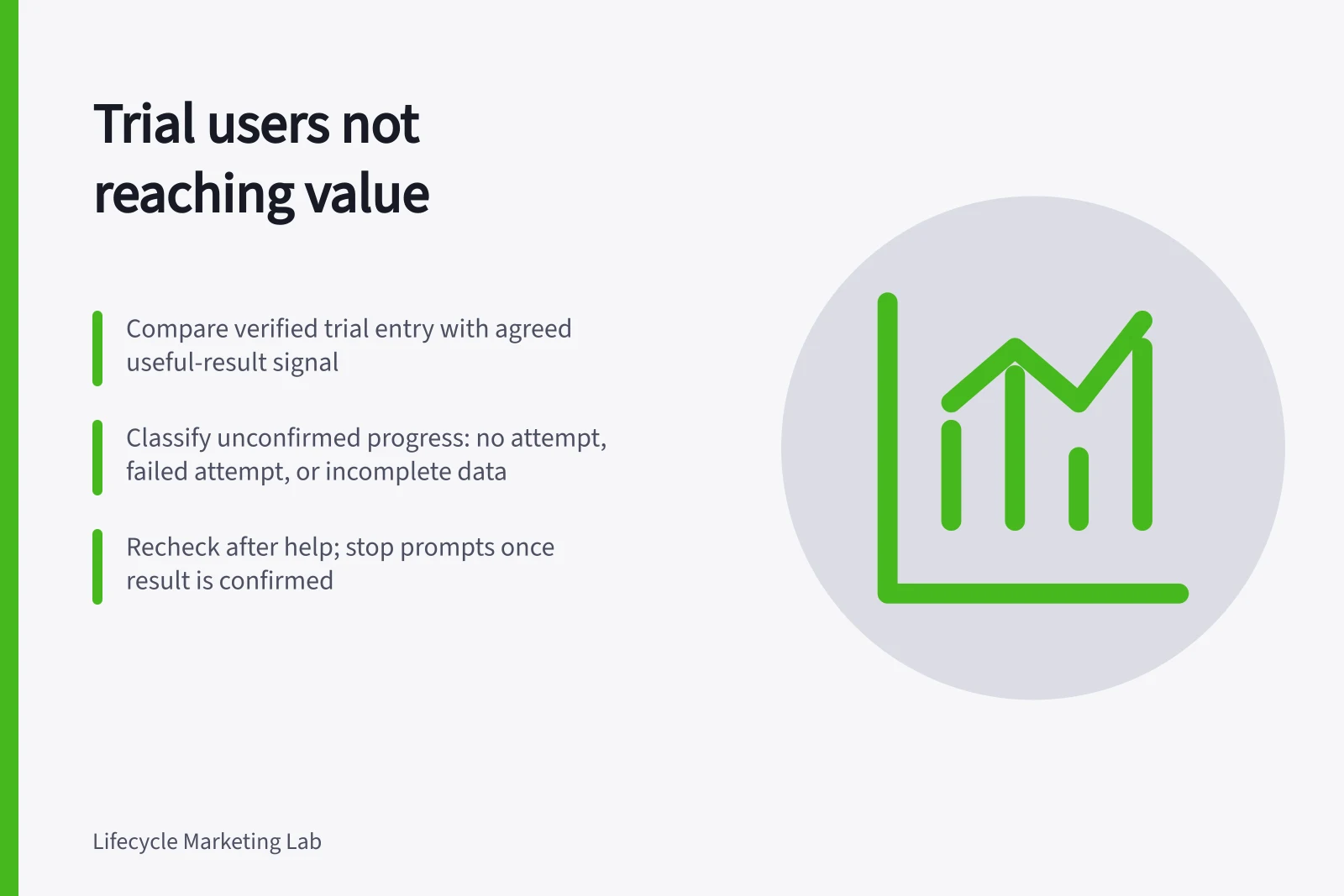
Identify trial users who have not yet reached value by comparing verified trial entry with an agreed useful-result signal. An absent result means progress is unconfirmed. Before offering help, distinguish no recorded attempt from a failed attempt and from incomplete data.
Key Considerations for Trial User Segmentation
- Verified trial entry
- Required for accurate segmentation
- Useful-result signal
- Must align with trial task definition
- ACMA compliance
- Required before sending commercial messages
Use a result that fits this trial
Start with the result already defined for the customer's trial task. In a hypothetical file-sharing product, a shared file opened by a colleague could be one candidate; an upload alone would show progress towards it. The product team must validate which result matters. This segment should apply that definition, not invent an activation event from convenient clicks.
Check that the completion record carries the right person or account, outcome and occurrence time. Decide whether success by one account member changes the account's status or only that person's. If success can occur outside the tracked product, identify how it is recorded.
Classify unconfirmed progress
| Observed history | What remains possible | Response to consider |
|---|---|---|
| No qualifying attempt recorded | The route may be unclear, or activity may be missing | Offer one accessible starting action. |
| Attempt with a verified failure | A specific obstacle is present | Offer the relevant fix or support. |
| Attempt with no reliable outcome | The customer may have progressed | Check the record or use cautious wording. |
A failed import needs different help from a customer who never opened the import tool. A missing success event may also reflect delayed tracking, an identity mismatch or work done elsewhere. Choose an observation window that gives the task a reasonable chance to finish; colleague-dependent work may take longer than an individual task.
Check the rule against trial histories
Review records representing immediate success, no attempt, a failed attempt, completion by another account member, a duplicate event and a late event. State the expected classification and response for each. Keep cases the rule cannot classify as unknown rather than silently treating them as failures.
Revisit the segment when the product adds another route to the same useful result. Keep the result-definition version with reports so a tracking change is not mistaken for a change in customer behaviour.
Offer help, then recheck
A message should point to the next useful action or remedy. Recheck progress and relevant support issues near dispatch. Once the result is confirmed, stop prompts for that first result.
Check the ACMA's guidance before sending commercial email or SMS. Count later confirmed results, but do not claim that the message caused them without a suitable comparison.