Onboarding Journeys
Part of Designing customer onboarding journeys
Choosing the first useful action after signup
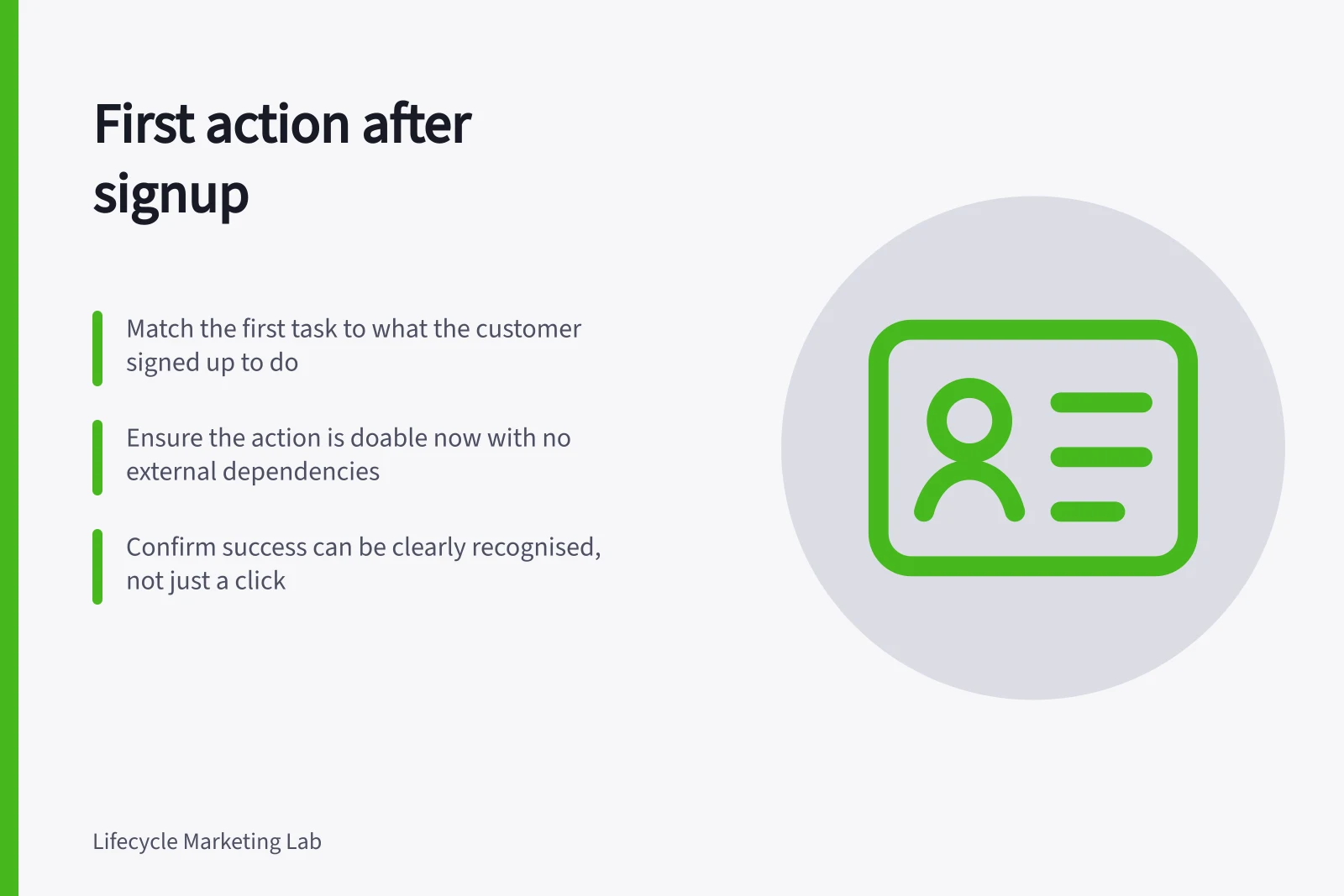
Choose an achievable first action that advances the customer’s signup goal, can be recognised as progress and leads to a clear next step.
Pick the first action after signup by finding a small result the customer can achieve now and that advances why they joined. An easy-to-count click is weak if it leaves them no closer to their task.
Start with the signup promise
Read the signup form, invitation or sales handover. What did the customer expect to do next?
In a hypothetical team workspace, someone starting a new project may need to create it. Someone invited to an existing project may need to open an assigned task. A generic profile prompt may help neither person.
If the reason for signup is unknown, offer a few clear routes or ask a useful question in the product. Record the route chosen so later guidance can follow it. Do not claim to know a customer's goal from signup alone.
Compare actions the customer can take now
List plausible first actions and ask:
Question / What to check
- Does it advance the task?
- Describe the result in the customer’s words.
- Can this person do it now?
- Check access, required information and dependence on someone else.
- Can success be recognised?
- Separate a completed result from a click or failed attempt.
- Does it lead somewhere useful?
- Make the next step or necessary wait clear.
- Can a failure be addressed?
- Identify the obstacle and a suitable help route.
A shared outcome may require another person. In that case, inviting the right colleague could be an honest first action, provided the customer understands what happens next. The first prompted action need not be the eventual onboarding completion event.
Check the choice against customer paths
Use interviews, support questions and representative product histories to challenge the proposed action.
Look for customers who performed it but still could not complete their task, as well as customers who reached a useful result another way. Either case may call for a different starting route.
An association between the action and later use is a clue, not proof that prompting it improves outcomes. Customers already motivated to continue may be more likely to do both. Keep the choice provisional until it has been checked against the customer's actual task.
Write the prompt
Name one action, explain how it helps and take the customer to where they can do it. Skip the prompt when the action is already complete. If an attempt failed, offer the relevant fix. If completion is uncertain, avoid wording that says it has not happened.
For a commercial onboarding email or SMS subject to Australian spam rules, check the recipient's applicable consent, sender identification and unsubscribe method. Signup alone does not establish permission to send marketing.
Revisit the chosen action when the product, access rules or signup promise changes. The useful first step is the one that gives this customer recognisable progress.
Compliance Requirements for Onboarding Messages (Australia)
- Sender identification
- Must include valid sender name and contact details
- Unsubscribe option
- Must provide a functional unsubscribe method