Onboarding Journeys
Part of Post-purchase customer education journeys
Coordinating education with a likely replenishment date
Education and replenishment answer different questions.
Education and replenishment answer different questions. Education helps a customer use the current product; replenishment asks whether they need another. Put them in one journey so a reorder prompt does not arrive before a planned first-use opportunity or during a service problem.
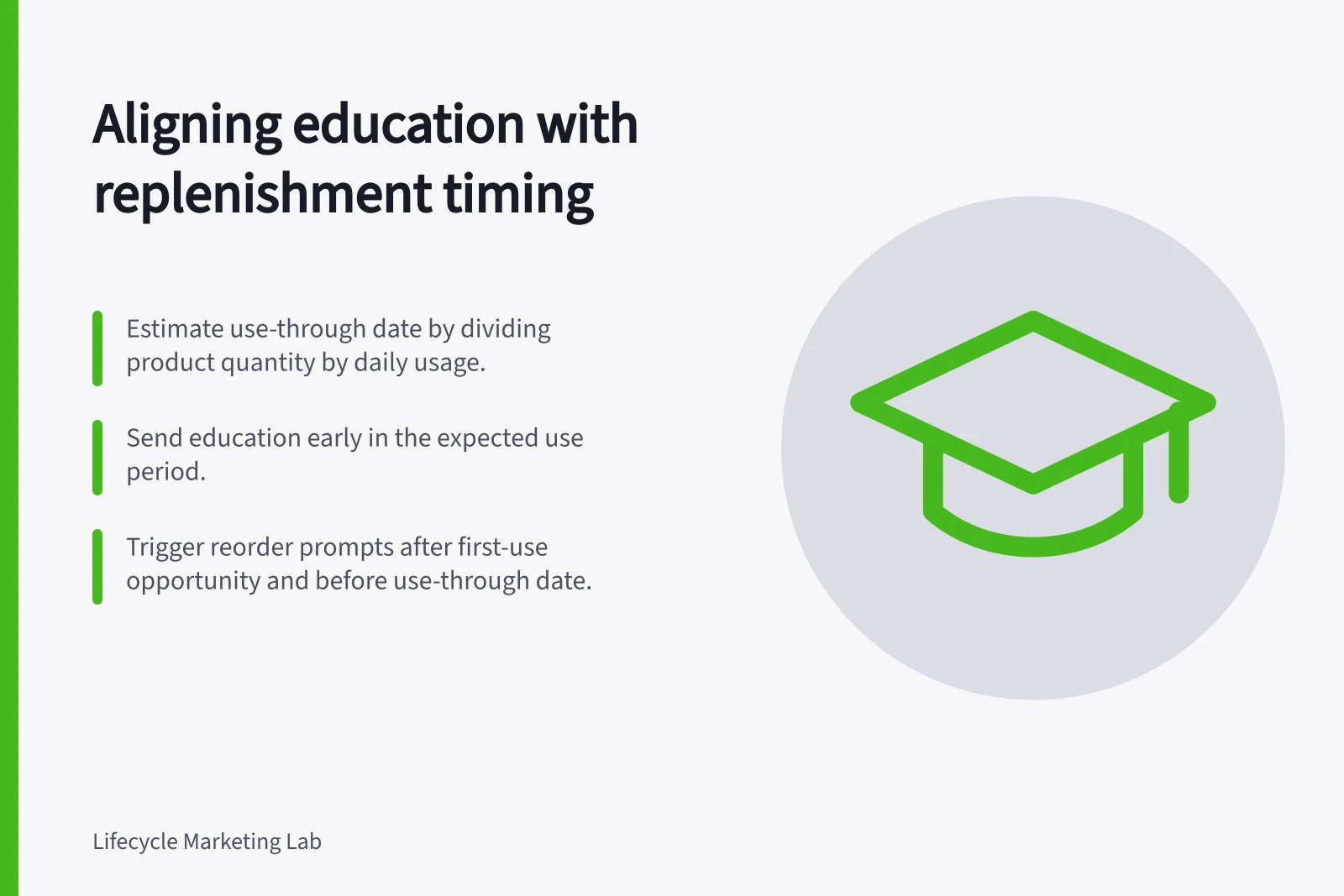
For a consumable, estimate days of supply by dividing the product quantity by typical use per day, using matching units. Add that interval to the delivery date to estimate the likely use-through date; treat it as a planning estimate, not a reading of the customer’s stock.
Send education early in the expected use period, then make the reorder prompt eligible only after a reasonable first-use opportunity and before or near the estimated use-through date. Actual use varies, so the date is a timing cue, not evidence that the customer has used the product or has stock remaining.
A durable product may need maintenance guidance rather than a repeat-purchase prompt. A consumable may warrant a reminder, but only after the customer has had a reasonable opportunity to use it.
Use the order date and delivery status to anchor and adjust the estimate. If an item was delayed, update the planned date; if it was returned or the customer already reordered, update the path and suppress the reminder.
Shopify Messaging offers post-purchase automations to encourage repeat purchases and engage customers after an order is placed. Verify the available trigger and test the specific event and suppression rules in your setup rather than assuming a trigger or rule.
For impact, compare similar customers and do not attribute every post-reminder reorder to the reminder; assess confusion-driven contacts separately.
Coordinating Education and Replenishment in a Customer Journey
- Order Placed
- Customer places order; delivery date confirmed
- Delivery Date
- Product delivered to customer
- Estimated Use-Through Date
- Delivery date + (product quantity ÷ average daily use)
- Reorder Prompt Eligible
- After reasonable first-use opportunity, before or near estimated use-through date
- Adjust for Delays/Returns
- Update timeline if delivery delayed, item returned, or reorder already made
Key Metrics for Coordinated Replenishment and Education
- Days of Supply Estimate
- Product quantity ÷ average daily use (same units)
- Use-Through Date
- Delivery date + Days of supply
- Reorder Prompt Timing
- After first-use window, before or near use-through date