Lifecycle Experiments
Part of Customer milestone and expansion journeys
Measuring expansion journeys separately from sales-led deals
Separate journey-eligible accounts, sales-owned deals and shared handovers before reporting expansion revenue or estimating impact.
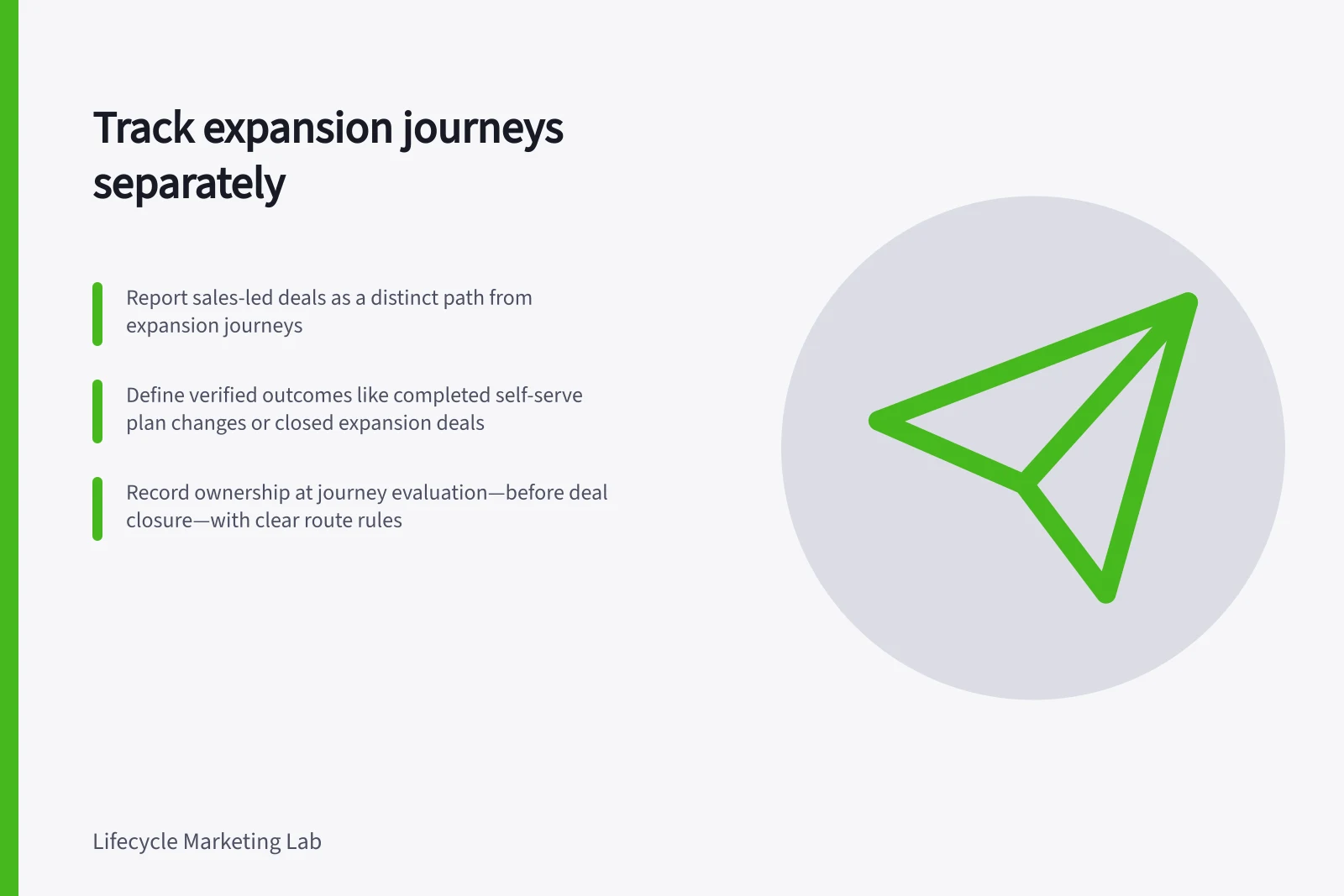
Measure an expansion journey against the accounts considered for it. Report sales-led deals as a separate path. A journey message may appear in the history of a deal negotiated by an account manager, but that exposure does not make the whole deal journey-created revenue.
Define the population and outcome
Choose the reporting unit first. If an organisation buys a shared plan, use accounts for expansion outcomes and contacts for delivery and engagement checks.
Record every account assessed by the journey rule, then show which were eligible, reached or excluded. An open support issue or active sales opportunity may explain an exclusion; counting only recipients hides those decisions.
Define a verified commercial outcome, such as a completed self-serve plan change or a closed expansion opportunity. Decide whether the reported amount is incremental recurring value or booked contract value, and keep the currency, period, date and treatment of reversals consistent with finance and CRM records. A click, plan-page visit or meeting request is not booked expansion.
Record ownership before the deal closes
At journey evaluation, label the account as a journey candidate, sales-led or undetermined. Record when a sales owner accepts a handover and when an opportunity begins. Preserve those changes even if the final purchase uses self-serve checkout; the checkout route alone does not describe the preceding work.
| Route | Count | Outcome to report |
|---|---|---|
| Journey candidate with no sales-led opportunity at entry | Eligible and reached accounts | Verified self-serve expansions |
| Sales-led at entry | Accounts with active expansion opportunities | Closed expansion deals |
| Handed to sales during the journey | Handed-over accounts | Deal outcome with both exposures recorded |
| Undetermined ownership | Accounts awaiting review | Outcome kept out of route comparisons |
The rows are reporting definitions to adapt to the organisation's records. Keep both marketing exposure and sales work visible, but do not add the same deal in full to two route totals.
Separate attribution from impact
Show the journey funnel: assessed accounts, eligible accounts, entries, deliveries, meaningful product actions, handovers and verified expansions within a declared window. Add revenue after the commercial records are joined and reconciled.
Platform attribution describes exposure under platform rules. It is not a ledger of all expansion activity or evidence that a campaign caused a deal.
Estimating incremental effect requires a holdout.
Critical Metrics for Expansion Journey Reporting
- Assessed Accounts
- Total accounts evaluated by journey rule
- Eligible Accounts
- Accounts meeting expansion criteria
- Meaningful Product Actions
- Actions indicating engagement (e.g., plan change, upgrade)
- Verified Expansions
- Confirmed revenue from self-serve or closed deals
Reconcile exceptions
Review large deals, changed ownership, duplicate account records and purchases following both journey and sales contact. Set a source of truth for final amounts and corrections. Track mistimed offers alongside revenue results.