Onboarding Journeys
Designing customer onboarding journeys
Design an onboarding journey around a useful customer result, with relevant help, clear entry and exit rules, and checks for outdated messages.
Design an onboarding journey around the result a new customer came to achieve. Map the steps towards that result, decide what help fits each situation, and stop routine guidance when it no longer helps.
Start with the customer’s task
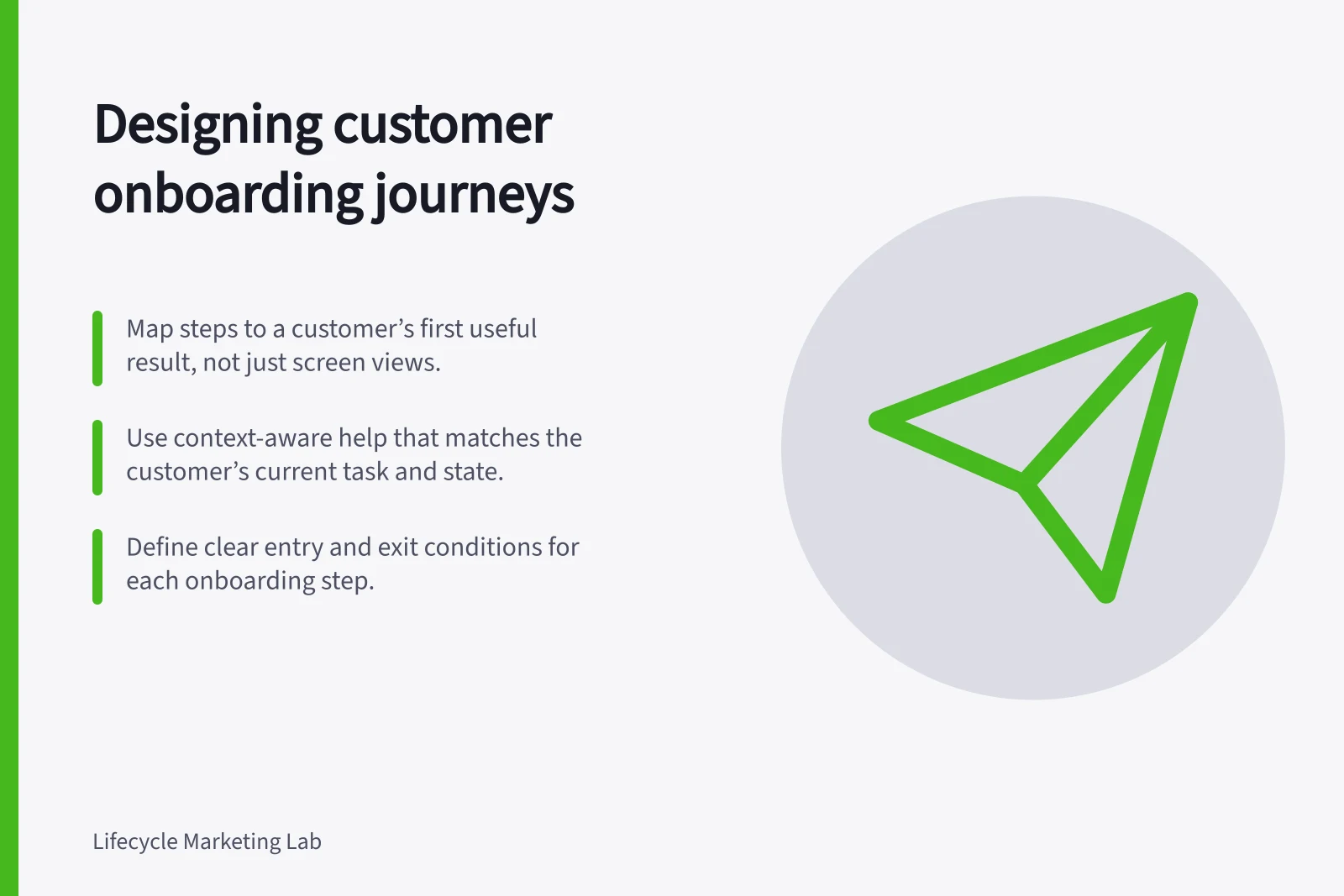
Write down what the customer wants to do, what must happen first and what would show useful progress. In a hypothetical team workspace, creating an account provides access; completing a shared task may be the first useful result. The right result depends on the product and the customer’s reason for joining.
Do not treat every screen view as progress. A person can open a setup page without finishing the task. Record what each observation confirms and what remains uncertain.
Shape the journey story
Before writing onboarding copy, outline the story the journey should tell: what the customer is trying to achieve, what they need to understand at each point and how the next step helps. This keeps the path focused on progress towards product value rather than a tour of features.
Treat content and product design as connected decisions. If customers need lengthy explanations to operate a control or complete a task, investigate whether the product itself is difficult to use instead of trying to solve the problem with more instructions.
Map the decisions
A short map can connect customer situations to responses:
| Customer situation | Possible response | Change or stop when |
|---|---|---|
| Access created; first task unconfirmed | Show a clear starting action | The task succeeds, a fault is reported or the record needs review |
| First task attempted but unsuccessful | Help with the obstacle | The task succeeds or a person takes over |
| First useful result confirmed | Offer a relevant next step, if needed | Further guidance would add no value |
These are planning states, not universal event names. Name the source and owner of each observation. Decide whether the journey runs for a person or an account: one member’s action may change what the whole team needs, while another member may still need individual help.
If completion data is late or missing, avoid a message that claims the customer has not started. Use cautious wording or hold the send when the uncertainty matters.
Choose the response
Help may appear in the product, by email, through a support handover or through a product change. Give each message one purpose and one next action. A customer blocked by failed setup needs help with that problem; another feature overview will rarely resolve it.
Review messages from other teams that address the same task. Remove repeated requests and check delayed sends against the customer’s current state.
Onboarding Response Options Compared
- In-product guidance
- Contextual help within the interface; low friction, high relevance.
- Email messaging
- Delayed or triggered follow-ups; useful for reminders but must avoid spam.
- Support handover
- Escalation to human agents; effective for complex issues, requires clear routing.
- Product change
- Improving usability to reduce need for guidance; long-term solution.
Make guidance fit the interface
At first use, customers may be unfamiliar with the product’s interface and need cues to find their way. Empty states, inline hints and tips can make an unfamiliar screen easier to understand and point towards useful progress without requiring a separate tour.
Use educational content and communication in context: the explanation should help with the task the customer is facing, and its timing should fit the stage they have reached. Consider the cost of adding friction as well as the benefit, and decide when onboarding should be complete rather than continuing guidance indefinitely.
Define entry and exit
State who enters, what pauses the path and what ends it. Confirmed completion can end a basic reminder. An unresolved setup issue can move the case to support. Decide separately whether a genuinely new task warrants another entry.
Check relevant conditions near each delayed send and inspect other queues that may still hold an outdated prompt. Automation exits and message checks depend on the platform and its configuration; a rule in one workflow does not clear sends elsewhere.
Configure exit conditions
Automation behaviour depends on its trigger, filters and configured exit criteria. In Customer.io, a person continues by default until they stop matching the trigger or filter conditions; explicit exit conditions can also be based on profile attributes, events or segment membership.
Customer.io treats multiple explicit exit conditions as OR statements: a person exits when any one is met.
Automated Onboarding Flow with Exit Conditions
- TriggerNew account creation or first task initiation
- FiltersTarget only new users with no prior activity or incomplete setup
- Exit conditions (OR logic)Any one met: task completed, profile attribute updated, segment membership changed
- Platform dependencyExit rules are specific to system configuration; not shared across workflows
Review customer histories
Before release, trace example histories for immediate completion, no first action, a failed attempt, a late event, completion by another account member and a support issue opened during a wait. For each, write down the intended entry, response, skip and exit, then inspect the configured path.
Choose an outcome and observation window before reporting. Count eligible customers, entries, sends, skips, confirmed results and prompts sent after they became irrelevant. Completion after a message does not by itself show that the message caused it.
Check friction before launch
Before release, verify that each prompt’s link or in-product destination works, support handovers reach the intended team, and the experience displays correctly on the devices and channels customers will use.
Compliance & Best Practice Metrics for Onboarding in Australia
- Spam avoidance compliance
- Follow ACMA guidelines to prevent unsolicited messages.
- Telemarketing & e-marketing risks
- Avoid common mistakes like misleading claims or lack of opt-out options.
- Tax reporting obligation
- If clients earn income from digital platforms, report under ATO guidelines.
- Digital identity verification
- Use trusted systems like BlinK ID for secure onboarding in regulated sectors.
In this guide
- Choosing the first useful action after signupChoose an achievable first action that advances the customer’s signup goal, can be recognised as progress and leads to a clear next step.
- Removing competing messages from an onboarding sequenceAudit onboarding messages for repeated or contradictory requests, set a priority for each customer situation and correct the send rules.
- Measuring onboarding completion by customer typeDefine customer types at onboarding entry, set a useful completion result for each and report rates with clear units and observation windows.