Lifecycle Segmentation
Part of Customer milestone and expansion journeys
Identifying a genuine readiness signal for an upgrade
Distinguish a meaningful upgrade need from weak activity signals using customer tasks, constraints, intent and a review of false positives.
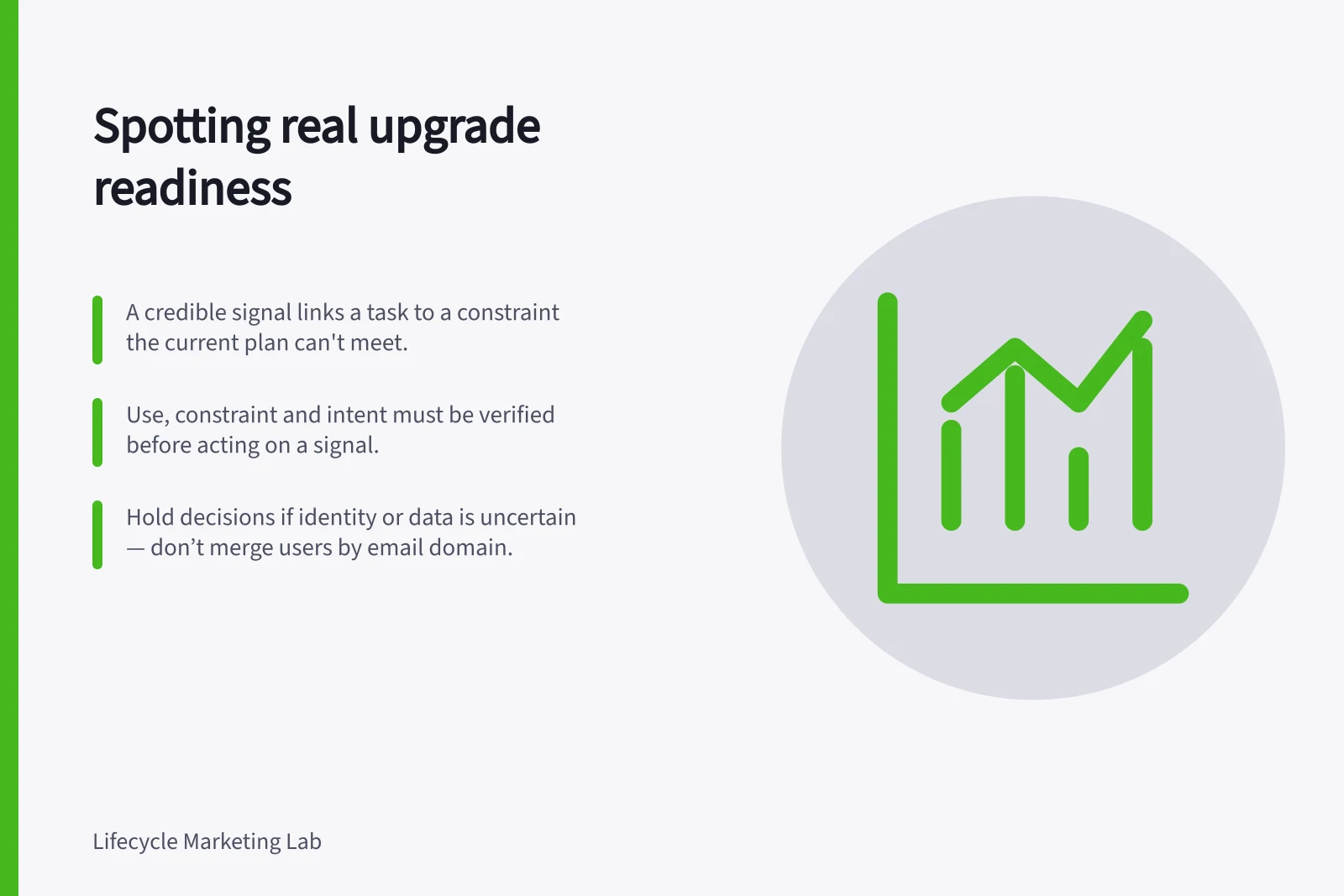
An upgrade signal is credible when it links a customer’s current task to a constraint the existing arrangement cannot adequately meet. A pricing-page visit, an anniversary or a single busy day may justify learning more, but none alone shows an upgrade would help.
Begin with the unmet task
Describe what the customer is trying to do before choosing a signal. For a team product, the task might be adding colleagues to a shared workflow. For a service, it might be handling sustained demand. Then identify the observation that shows the current arrangement is making that task harder.
Keep three kinds of evidence separate:
- Use:
- What has the customer achieved with the current purchase?
- Constraint:
- Which limit or missing capability affects the task now?
- Intent:
- Has an appropriate contact asked about options or requested a change?
Use and a verified constraint together support a more relevant explanation than use alone. An explicit request deserves a direct response, though the contact may be researching for a later budget cycle or on someone else’s behalf.
Look for other explanations
A usage spike may be a one-off project. Repeated attempts at a feature may show confusing instructions. Several colleagues viewing plan details may be checking what they already own. List these alternatives before deciding what the signal permits.
Set a time window and decision unit that match the purchase. A team plan calls for account context, while a message to an individual should reflect that person’s role and channel eligibility. Do not merge users into an account solely because they share an email domain. If identity is uncertain, hold the commercial decision for review.
Treat missing data as unknown. A blank usage field does not prove inactivity or readiness. Review how the analytics tool handles missing values before turning a numerical condition into a rule.
Signals vs. False Positives in Upgrade Readiness
- True Upgrade SignalRepeated use of a feature + constraint affecting key task + verified intent
- False Positive: One-off project spikeHigh usage on a single day with no ongoing pattern or constraint
- False Positive: Confusion or learning phaseMultiple attempts at a feature without clear progress or error logs
- False Positive: Existing plan reviewMultiple colleagues viewing plan details without change requests
Key Metrics for Upgrade Readiness Signals
- Constraint presence
- Verified capacity limit or missing capability
- Intent indicators
- Contact message or plan comparison request
Match the signal to the next action
Successful use without a constraint may call for guidance on the current arrangement. A verified capacity limit affecting an important task may justify explaining available options. If a named contact asks for a proposal, route the request to its owner and stop generic upgrade prompts.
A working rule could require evidence of current use, a present constraint and no unresolved issue that explains the behaviour. This is a candidate rule, not a universal threshold. Review accounts that qualify and accounts that nearly qualify.
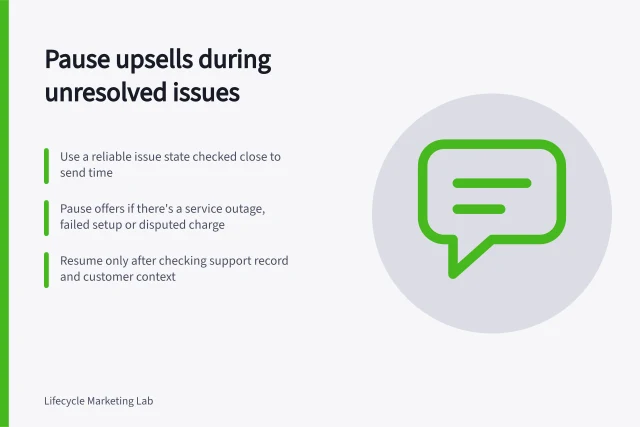
Include those already upgraded, in a sales conversation or dealing with a support problem. If the proposed message would look misplaced beside the customer’s full history, revise the rule or choose an educational response.
Record the signal definition, data source, decision unit and override conditions. Revisit them when the product, plans or customer behaviour changes.