Onboarding Journeys
Part of Customer events and lifecycle segmentation
Defining activation events that indicate real progress
Choose an activation event tied to a customer's first meaningful result, specify it precisely and check what it says about progress.
An activation event should mark an observable early result that brings a new customer closer to the value they sought. Signup, login and page views may explain the route, but they do not necessarily show that result. Choose a candidate event, check what it represents and state what remains unobserved.
Activation Events vs. Non-Activation Signals
- Signup
- Indicates interest but not value delivery.
- Login
- Shows access but not meaningful use.
- Page View
- Tracks movement, not achievement.
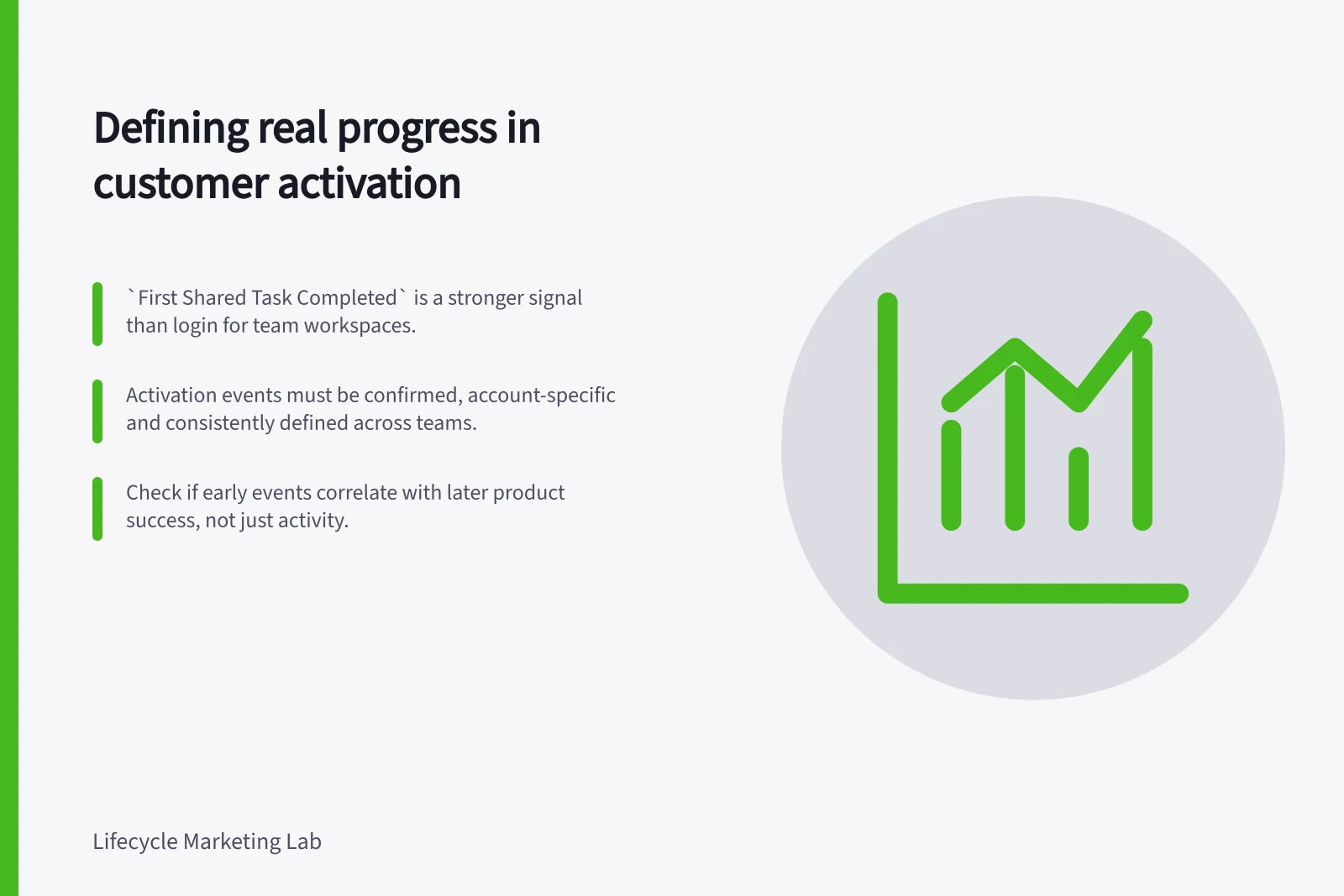
- `First Shared Task Completed`
- Confirms a meaningful early result aligned with product purpose.
Start with the customer's task
Ask what the customer needed to accomplish, then work back to evidence the business can record. In a team workspace, Project Created might show setup. First Shared Task Completed could be a stronger activation candidate if shared work is the service's purpose. It still would not prove the team found the result useful or will return.
A useful candidate records a confirmed outcome, belongs to the right person or account, occurs early enough to guide a response and has a definition teams can apply consistently. Different customer jobs may need different activation definitions. For a shared account, decide whether the milestone belongs to one user or requires an account-level outcome.
Specify what counts
Document the event name, source system, completion condition, customer and account identifiers, occurrence time, required properties and treatment of duplicates or reversals. If an action can fail after a button is pressed, a click should not count as a completed result.
For example, First Shared Task Completed might require a task ID, account ID and confirmed completion state. These fields are illustrative; the actual source of truth depends on the product. Keep the first valid completion separate from current engagement.
Later inactivity may change the customer's next need without undoing a genuine first completion. A completion recorded in error needs a correction.
Check whether the event is meaningful
Compare new-customer histories with and without the candidate event. Inspect what was completed, whether the result was usable and whether those customers later reached an outcome that matters for the product. Choose the cohort and observation period before interpreting the pattern.
An association with later use is a signal, not proof that causing the event would improve retention. Customers who are already motivated may be more likely both to complete the task and to return. Customer or support evidence can help establish whether the action delivered value. If many customers record the event yet still fail to get started, tighten its definition or choose a later result.
Avoid importing an activation threshold from another product. The customer task, account structure and usage rhythm may differ. Record the definition so product, marketing and analytics count the same milestone.
Key Metrics for Activation Validation
- Retention Rate (7-day)
- Higher among users who completed the activation event.
- Time to First Value
- Shorter for users who achieved activation quickly.
- Event Completion Accuracy
- Ensure no false positives from failed actions or duplicate entries.
Use the result to guide a response
For a customer without a confirmed activation event, distinguish a failed step from a task that has not begun. The first may call for troubleshooting; the second may call for a clear starting point. If the feed is delayed or identity is uncertain, avoid saying the customer has failed to make progress.
Once activation is confirmed, suppress prompts for that same first task. Any later message should address the next relevant need. Review sample histories for false positives and false negatives when the product or event implementation changes.