Journey Governance
Lifecycle content mapping
Build a lifecycle content map around customer questions, supporting evidence, content jobs and the conditions that make a message stale.
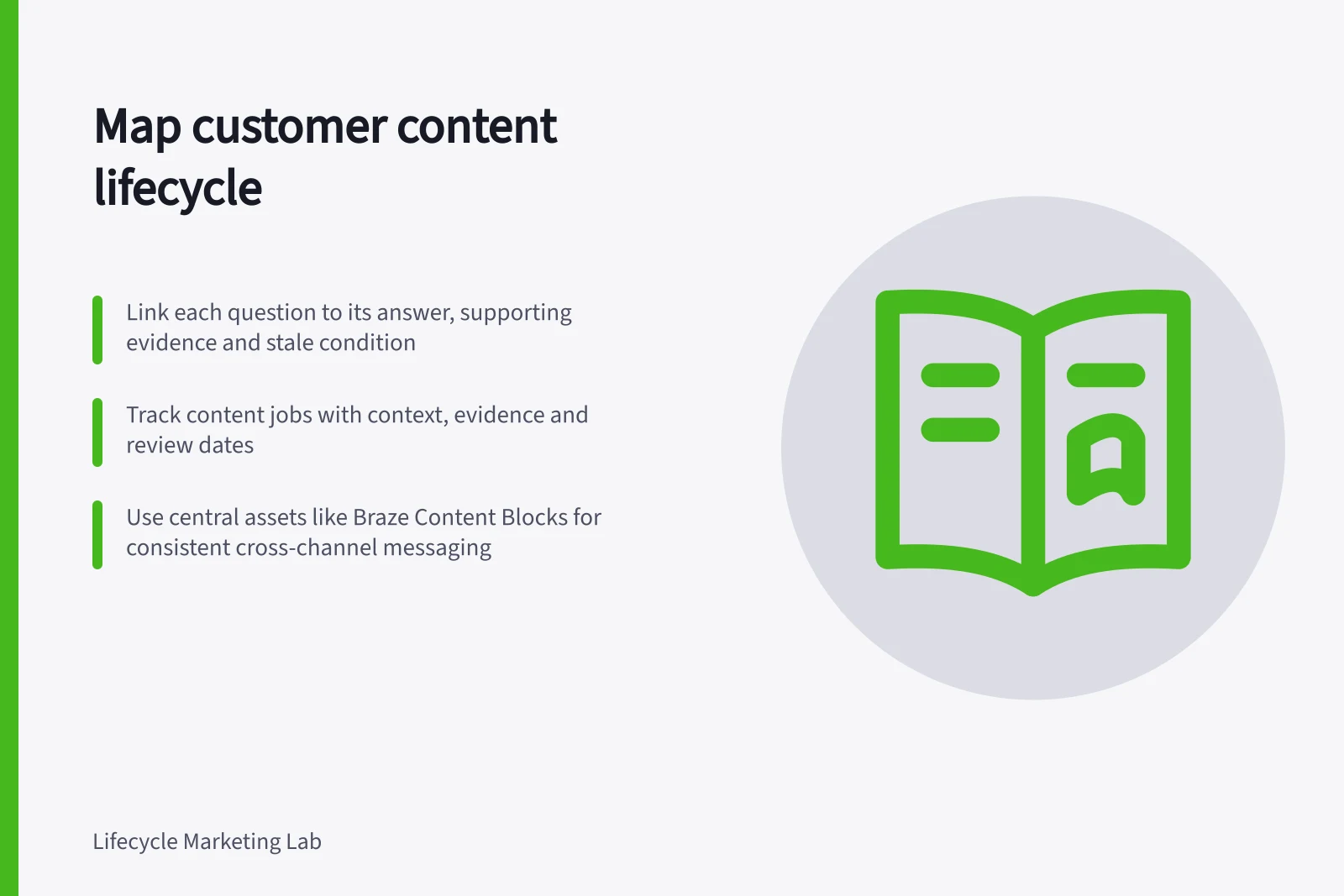
Lifecycle content mapping links a customer question to a useful answer, the evidence that makes it relevant and the condition that makes it stale. Build the map before filling a journey with messages. It should expose missing answers, repeated content and claims the team cannot support.
Map questions, not just stages
A stage is a useful organising label, but customers at the same stage may need different answers. One new customer may be choosing a first task; another may be stuck on it. Start with a specific situation and write the question in the customer’s terms.
| Illustrative situation | Question to investigate | Content job | Evidence needed |
|---|---|---|---|
| Account created; intended task unclear | Where should I begin? | Show available starting routes | Confirmed account access |
| Task attempted; error recorded | How do I get past this? | Explain the relevant fix or route to help | Current error and task record |
| First task confirmed | What can I do next? | Explain a useful next capability | Verified result and current access |
| Plan limit reached | What are my options? | Explain applicable options and terms | Current plan, limit and account status |
These prompts guide investigation; they are not claims about every customer in those situations. A pricing-page visit may reflect curiosity, comparison or a question about an existing plan. On its own, it does not identify a price objection.
Give every content item a job
For each proposed item, record its question, answer, next action and the evidence required for its wording. Add recipient and account context where they differ. Then state what should stop, replace or expire the item. A setup message should not remain a routine send after setup is confirmed.
A practical content record can contain a stable ID, customer question, approved claim, next action, eligible situations, required product or offer facts, channel versions, owner, review date and stale condition. This is an editorial specification; it does not assume a messaging platform supplies those fields.
Separate the answer from its delivery format. An email can carry detailed steps worth keeping, while an in-product prompt can point to the action available on screen. Both may answer the same question, but each needs wording that works where it appears. Do not duplicate an instruction merely to fill another channel.
When an answer is reused, note which approved answer each asset carries and review each use when its underlying fact changes. Braze supports drag-and-drop and HTML Content Blocks, for example.
Find gaps and contradictions
Put existing emails, in-product text, SMS, help content and approved offers against the questions they answer. Look for a question with no answer, several versions of the same answer, a link to a removed feature, or a message that assumes an outcome the records cannot confirm.
Prioritise gaps by consequence. Wrong information about access, a deadline or an offer needs attention before a missing optional tip. If a fact is uncertain, hold the specific claim or use wording that remains accurate. Missing data does not justify ‘you have not completed’ copy.
For Australian commercial email and SMS, check current ACMA guidance before sending. Assess the whole message when an offer is added to practical guidance.
Australian Email and SMS Compliance Requirements
- Unsubscribe MechanismMust provide a clear, functional unsubscribe link in every commercial email and SMS.
- Opt-In RequirementNo sending without prior consent; opt-in must be freely given and unambiguous.
- Content AccuracyClaims about offers, pricing or access must be accurate and verifiable at time of send.
- Data ProtectionPersonal data used in messaging must comply with privacy laws, including ATO and OAIC guidelines.
Connect mapped answers to reusable assets
Keep the map connected to the assets that carry its approved answers. A central register can point from a question and claim to the reusable content item, its channel versions and its review owner. This makes it easier to spot when one answer is maintained in several places, rather than treating each send as an unrelated piece of copy.
Braze describes Content Blocks as a way to manage reusable cross-channel content in one central location, including consistent messaging and offer codes used across channels. If a team uses them, record the relevant block alongside the mapped content item. The map still needs to specify the customer situation, evidence and stale condition that make the answer appropriate.
Keep platform conventions in mind when choosing identifiers. In Braze, a Content Block name is required, limited to 100 characters and restricted to letters, numbers, dashes and underscores. Names cannot be changed after saving, and a name from an archived block cannot be reused. Choose a durable naming pattern before creating the assets.
A short asset description can help other users identify a block’s purpose and where it belongs; Braze allows an optional description of up to 250 characters. Its preview can show how an email block appears for a random user, and a copied preview link lasts seven days before it must be regenerated. Treat that preview as a review aid, not as a replacement for checking the mapped claim and evidence.
Keep the map current
Use the map when a journey is built, an offer changes or a product feature moves. Identify content that depends on the changed fact, then review its channel versions and waiting sends.
Review representative customer histories: quick progress, a failed attempt, unknown status and account terms changing during a delay. For each, ask whether the mapped answer remains accurate and useful when it would appear. Record unresolved gaps for the appropriate content, product or service owner.
In this guide
- Matching the next message to a customer's current questionUse current evidence to choose a message that answers one likely customer question without assuming an unverified motive or task status.
- Building reusable message modules for journey stagesDefine reusable message modules with a clear purpose, current facts, allowed contexts, fallbacks and a review process for every channel version.
- Keeping stage-specific offers consistent across channelsUse one approved offer record to align eligibility, benefits, exclusions and expiry across messages, landing pages and checkout.
- Updating lifecycle content after a product changeTrace a product change through lifecycle messages, prioritise inaccurate claims and review shared content and queued sends before release.