Journey Governance
Assigning owners to customer stages and event definitions
Decide who owns each lifecycle stage’s meaning, event data and use in customer journeys.
Desk
Examines how lifecycle teams test journeys and review their results over time.
Journey Governance
Decide who owns each lifecycle stage’s meaning, event data and use in customer journeys.
Lifecycle Experiments
Choose a journey holdout using eligible volume, baseline outcomes, the smallest useful effect and the time available for a fair comparison.
Lifecycle Experiments
Compare eligible journey and holdout groups fairly by separating assignment from delivery, aligning outcome windows and checking contamination.
Renewal Journeys
Assess whether a lifecycle journey still serves a customer need and plan the exit for new and active customers.
Lifecycle Experiments
Use an eligible holdout and a shared outcome window to separate what a lifecycle message may add from progress customers make anyway.
Lifecycle Experiments
Use trial tasks, failures and customer responses to distinguish product friction from stated price concerns.
Lifecycle Experiments
Evaluate a first-purchase journey by asking whether it helps eligible people buy, and at what incentive cost.
Journey Governance
Build a lifecycle content map around customer questions, supporting evidence, content jobs and the conditions that make a message stale.
Lifecycle Experiments
Plan a lifecycle test with a clear customer outcome, fair assignment, a defined holdout and an honest readout of what changed.
Journey Governance
Plan lifecycle marketing around customer needs, observable progress, message controls and meaningful outcomes across the journey.
Journey Governance
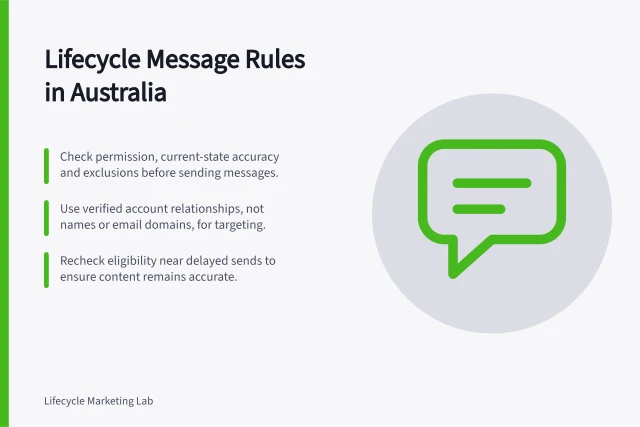
Define entry, permission, exclusion, priority, send and exit rules so lifecycle messages remain accurate and appropriate.
Journey Governance
Keep live customer journeys visible, monitor entry and sending separately, respond to data outages and review operational faults.
Journey Governance
Assign owners for lifecycle definitions, live journey changes, shared outcomes and retirement decisions.
Journey Governance
Build a lifecycle measurement plan around eligible customers, verified progress, cohort windows, exceptions and a fair assessment of impact.
Lifecycle Experiments
Separate journey-eligible accounts, sales-owned deals and shared handovers before reporting expansion revenue or estimating impact.
Lifecycle Segmentation
Define customer types at onboarding entry, set a useful completion result for each and report rates with clear units and observation windows.
Onboarding Journeys
Define a first useful result, align onboarding cohort clocks and compare both time to value and the share of customers who reach it.
Lifecycle Experiments
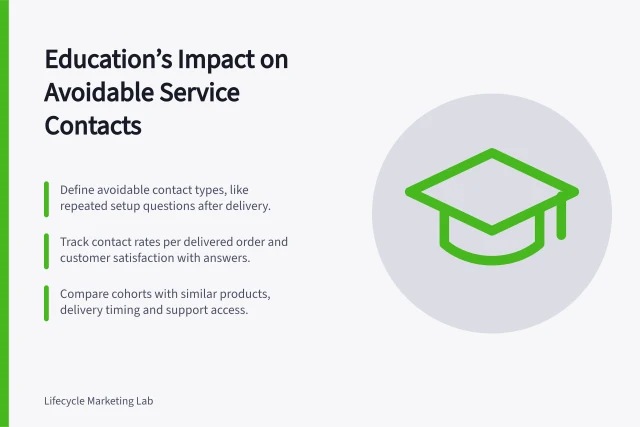
An education journey should reduce questions it can genuinely answer, without making help harder to reach.
Lifecycle Experiments
Document an unfavourable or inconclusive journey test with its original decision, uncertainty, integrity checks and next action.
Journey Governance
Run a quarterly review of live journeys using current rules, exceptions, customer histories and specific follow-up decisions.
Lifecycle Experiments
Use sample customer histories to verify sends, skips, holds, exits and unintended exclusions before a lifecycle journey goes live.
Lifecycle Experiments
Compare two journey schedules fairly while keeping the offer fixed, using one assignment clock and a shared customer-outcome window.